
← Equipment management glossary
Also called: equipment cage, gear room, cage.
The lens went out on Friday for a two-day shoot. On Wednesday the next crew came for it. It was in a bag in an edit suite, and nothing had said it was late.
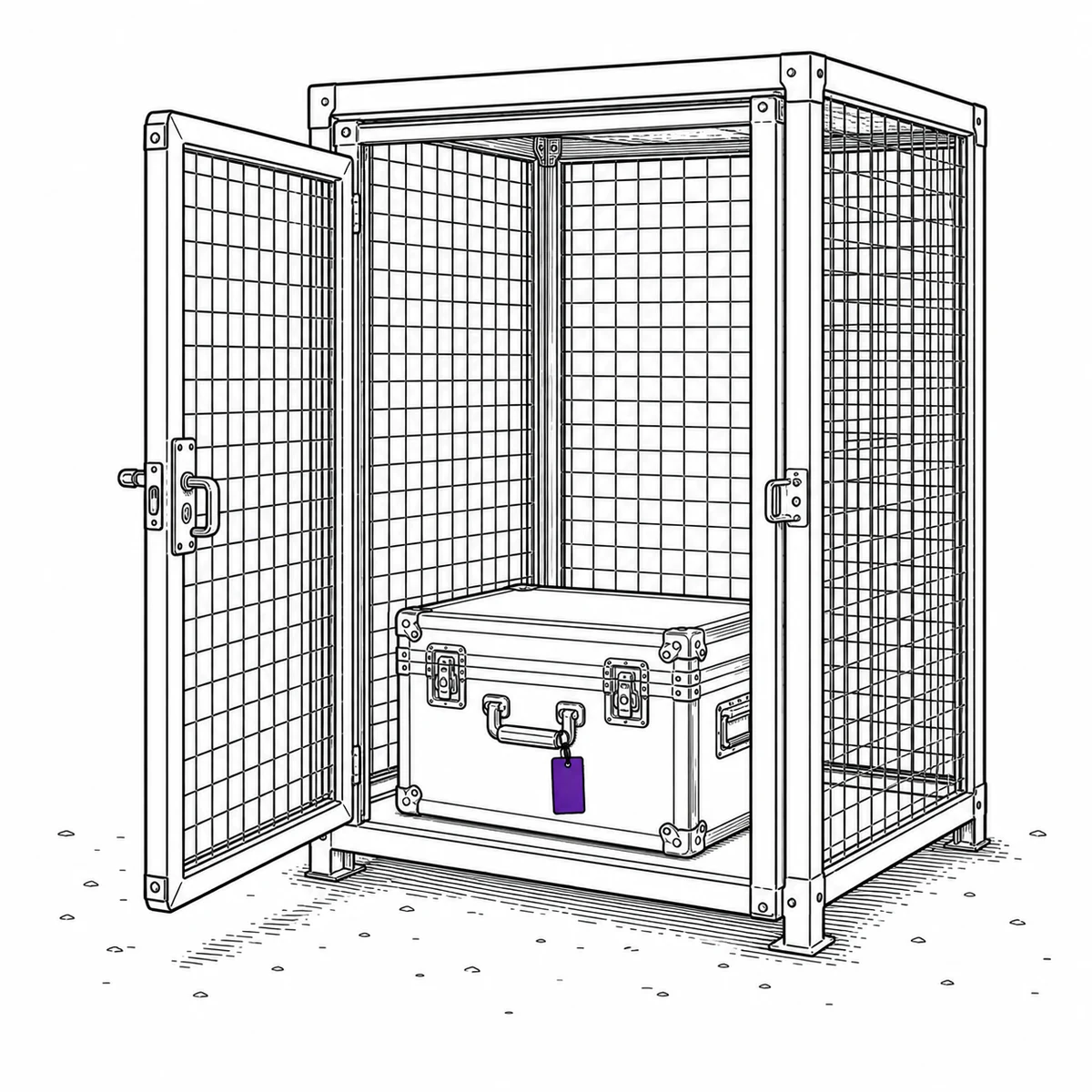
A cage is a controlled boundary: equipment inside is available, equipment outside is someone’s responsibility. Everything else is process.
How a cage actually runs
Request or book
The user says what they need and when.
Issue and record
The cage manager hands it over and records who took what. Seconds, usually by scanning rather than typing.
Out on the job
Custody sits with a named person, and an overdue item surfaces on its own rather than when the next user needs it.
Return and check
Condition checked, kits checked in by contents rather than as one object.
and it is available again
The interesting part is what happens at the edges — kit that comes back incomplete, gear returned after hours, items that go straight from one production to the next without passing through the cage. Cages that run well have an explicit answer for each.
The four recurring problems
Incomplete returns. A camera package goes out as one thing and comes back missing a cable, discovered by the next user. Checking kits in as a list of contents rather than as one item is the fix.
Double bookings. Two productions promised the same lens, discovered on the shoot day.
The parallel record. A whiteboard or notebook that the cage manager trusts and the official system does not reflect — usually because the official system is too slow to update at the counter.
Gear that never comes back. Not stolen, just absorbed into someone's desk, kit bag or edit suite, with nobody chasing because nothing flagged it as overdue.
What makes a cage self-running
Cages that stop depending on one person's memory share three traits. Issuing takes seconds, usually by scanning rather than typing. Overdue items surface without anyone reviewing a list. And users can see availability themselves, which removes most of the traffic that makes the counter the bottleneck.
What goes wrong without it
A cage that runs on one person's memory works well until that person is on holiday — at which point nobody knows what is out, what is due, or what is missing.
How Itefy handles it
Itefy handles the cage workflow: bookings with conflict prevention, scan-to-issue checkouts, kits checked in by contents, and overdue items flagged automatically. Read more.