
← Equipment management glossary
Also called: barcode asset tracking, barcode inventory tracking.
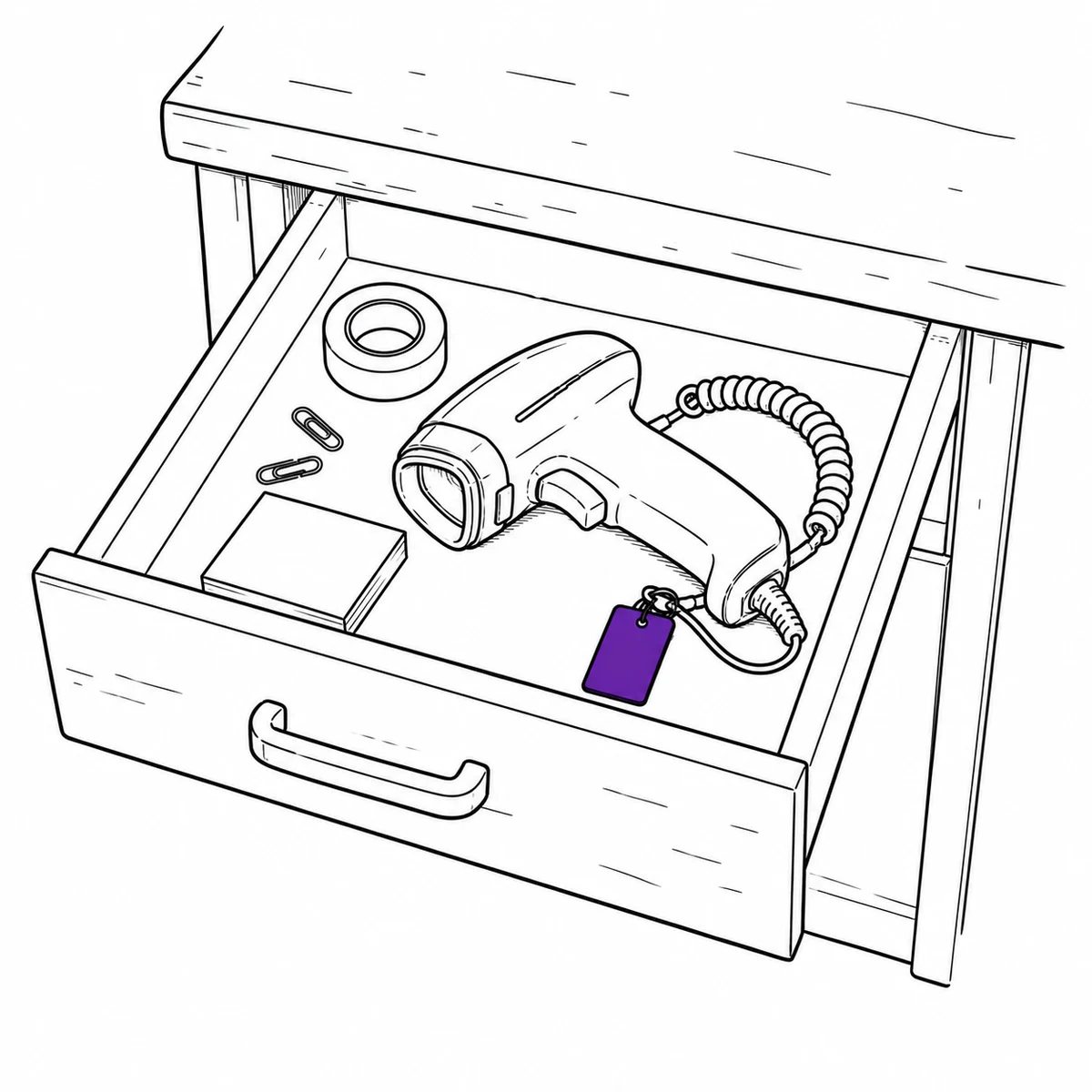
We bought two hundred labels and a scanner. By the end of the winter the labels on the excavators had gone, and the scanner lived in a drawer at the office.
The code carries an identifier, not information. Everything meaningful lives in the database it points at — which is why the label is the cheap, replaceable part.
Barcodes, QR codes and RFID
1D barcode
The striped kind. Compact, needs a reasonably clean line of sight, and generally wants a dedicated scanner to be pleasant to use.
QR code
Holds more, survives partial damage, scans from more angles, and reads reliably with an ordinary phone camera.
no hardware to buyRFID
No line of sight, and reads many tags at once — genuinely transformative for a whole pallet or a doorway. Costs materially more per tag and needs readers installed.
For equipment tracking the phone camera usually decides it: nothing to buy, and everyone already carries a scanner. RFID earns its cost in high-volume, high-throughput settings, and rarely in a gear room.
What the code actually does
A barcode carries an identifier, not information. Scanning it looks that identifier up in a database, which is where everything meaningful lives. This is worth understanding because it means the label is the cheap, replaceable part — and that the same physical item can be relabelled without losing its history.
The benefit is not speed for its own sake. It is that scanning removes transcription errors and removes the need for anyone to know an item's reference number.
Where labelling goes wrong
Two practical failures account for most disappointment. Labels placed where they get worn away, painted over or covered by a grip — so choose a flat, visible, low-contact surface. And labels of the wrong material for the environment: paper on outdoor plant, or standard adhesive on anything that gets hot, wet or solvent-cleaned.
For equipment that lives outdoors or in workshops, budget for laminated or synthetic labels. Reprinting hundreds of labels because the first batch dissolved is a common and avoidable cost.
What goes wrong without it
Without scannable labels, every record depends on someone correctly reading and typing an identifier — which is why manually maintained registers accumulate items that exist twice and items that exist nowhere.
How Itefy handles it
Itefy generates print-ready QR label sheets for your existing label stock, scannable with any phone through the Itefy Go app — no scanner hardware required. Read more.