
Medical equipment maintenance log: keeping a clinic's shared devices serviced, calibrated and findable
The portable ultrasound is in whichever room used it last and the ECG's annual safety test was due in March. A device register and service log for clinics, practices and physio rooms.
In this article
- What goes on the record
- Setting intervals so they survive people
- The two questions the log has to answer
- Faults, specifically
- What this article is deliberately not
- Where Itefy fits
The portable ultrasound is in whichever treatment room used it last. The annual electrical-safety test on the ECG was due in March, and nobody noticed because the person who used to notice left in February. Now an inspector is in reception asking for the service history of a specific unit, and the answer is a sticker on the back of the machine.
This is a small-practice problem, and it has almost nothing in common with hospital asset management. A hospital has a biomedical engineering department, an RTLS deployment and a biomed CMMS bought through procurement. A clinic has a practice manager, a cupboard, and a lot of things that need testing on a schedule nobody owns.
Written for the second one.
What goes on the record
One entry per physical device — not per model, per device, because the whole point is being able to say something specific about this unit.
Identity
- Make, model, and the serial number, which is what an inspector and a manufacturer both ask for first
- Your own asset number, on a label on the device
- Where it normally lives, and which room or clinician is responsible for it
Money and provenance
- Purchase date, supplier, price
- Warranty expiry
- The manual — attached to the record, not in a drawer
Service
- The service interval from that device's manual, not a generic annual default
- Calibration interval, where it differs
- Electrical safety testing date, where it applies
- Next due date for each of those
History
- Every service, calibration and repair: date, who did it, what was done
- Every fault reported, and how it was resolved
The history is the part that matters most and is skipped most. A sticker on the back tells an inspector the last date. The log tells them the pattern, which is what they are actually assessing.
Setting intervals so they survive people
Three rules that make the difference between a log and a wall of overdue dates.
Take the interval from the manual, per device. Devices in the same room can be on six-month, annual and two-year cycles. A single default is how the outlier gets missed.
The reminder goes to a role, not a person. "The practice manager" survives the practice manager changing jobs. A calendar entry in one person's Outlook does not.
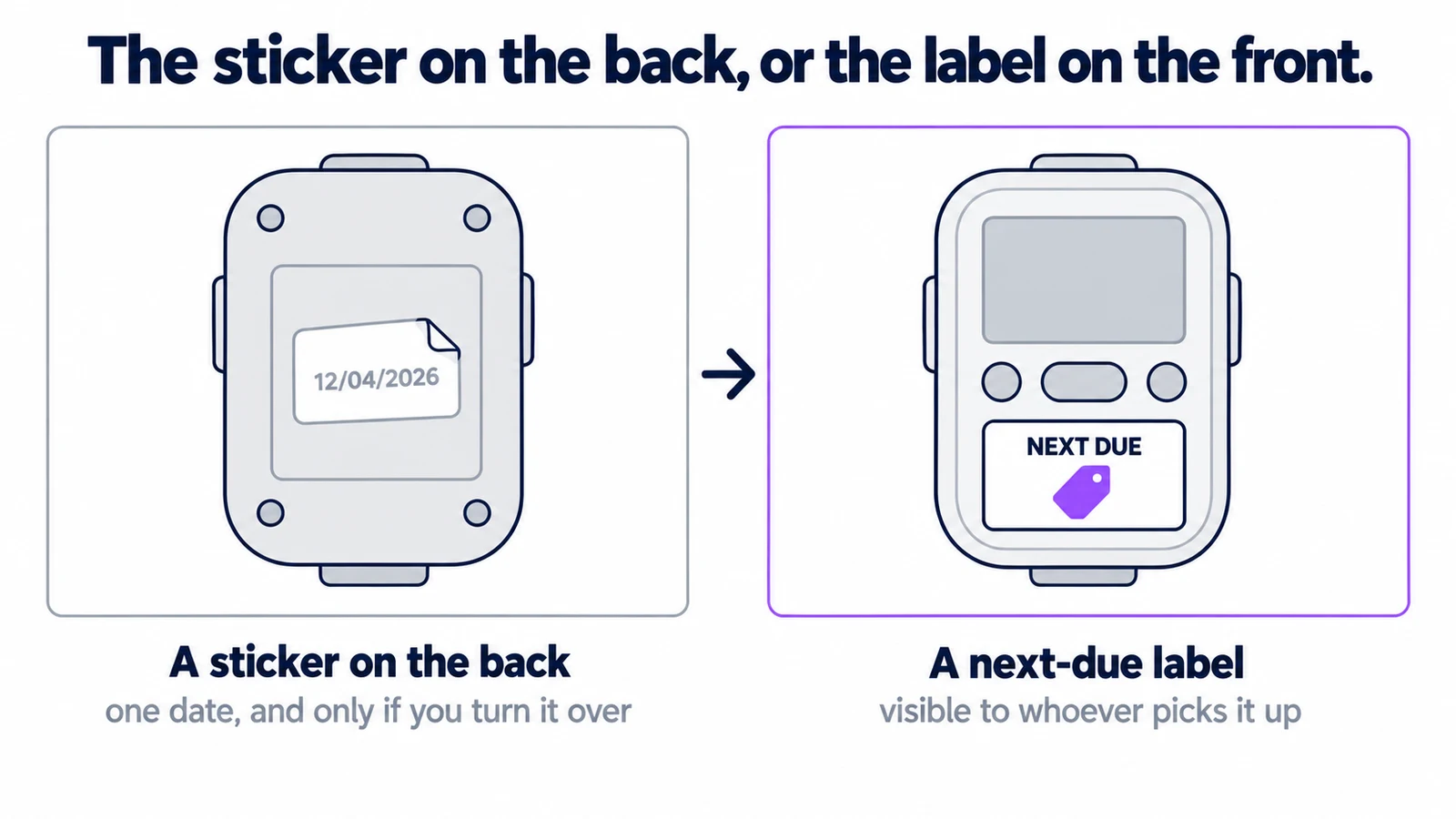
Put the next-due date on the device. A small label with the next date, replaced at each service. It costs nothing, and it means anybody who picks the thing up can see it is overdue without opening anything. This is the single highest-value habit on this page.
The two questions the log has to answer
"Where is the portable ultrasound?" — the reason devices go missing in clinics is not theft, it is that shared portable equipment ends up wherever it was last used, and nobody logs the move. Give each device a home room, and expect people to return it there. The register tells you where it should be; the last recorded move tells you where it probably is.
"Show me the history of this unit." — asked by an inspector, a manufacturer handling a fault, or an insurer after an incident. If the answer requires phoning a former employee, you do not have a log.
- Out of use, before telling anyone
- Labelled and moved, not just mentioned
- Tested by whoever the device requires
- Back in service, with the dates on its record
Faults, specifically
Clinical equipment has a failure mode that ordinary gear does not: a device that is faulty but plausible. It powers on, it produces a reading, and the reading is wrong.
So the rule has to be stricter than "report it if it is broken":
- Anyone who suspects a device is not reading correctly takes it out of use, immediately, before raising it with anybody.
- The device is physically labelled and moved, not just mentioned.
- It comes back into use only after it has been tested — by the manufacturer or a qualified engineer where that is what the device requires.
- The whole episode goes on the device's record, including the dates it was out of service.
That last point protects you. If a result from that period is ever questioned, the record of exactly when the device was withdrawn is the answer.
What this article is deliberately not
Compliance advice. Which standard applies to your devices, what your regulator expects, and what your indemnity requires are specific to your jurisdiction and your practice, and a blog post that gestured at them would be worse than useless. The operational habit — a register, real intervals, a real history — is what makes any of those conversations answerable. The requirements themselves are for your regulator.
Where Itefy fits
A spreadsheet does this until it does not, and the failure point is usually the same: the dates are in the sheet and the sheet is not what anybody looks at.
In Itefy each device is an item with its serial number, manual, purchase record and photographs attached, and maintenance scheduled by date with a reminder before it falls due — per device, on its own interval, notifying regardless of who is on shift. Every service, repair and fault stays on the item's own history, so "show me the history of this unit" is one screen rather than an archaeology exercise.
Anyone can report a suspected fault from a phone with a photo, and a device marked inoperative stops being available until somebody signs it off — the withdraw-from-use step, enforced rather than remembered.
Two honest limits. Intervals are by date, not by usage hours or cycle counts; if your service schedule is driven by a counter on the device, Itefy will not read it. And there is no location beacon — a device's location is where somebody last recorded it, which answers "where should it be" and not "where is it this second".
See equipment management for healthcare, or start a 14-day free trial with no card and load one room's devices.
Frequently Asked Questions
-
No. A hospital's biomedical engineering department runs a dedicated biomed CMMS bought through procurement, and should. This is for the clinic, practice, physio room or community service with somewhere between twenty and a few hundred devices and no biomed department.
-
The manufacturer's, for each device, taken from its manual and written on the record. There is no general answer, and a generic annual default is how a device with a six-month requirement gets missed.
-
It is usually a necessary part of the answer, not the whole of it. This article is about the operational habit of keeping one; what your specific regulator requires is a question for your regulator and your indemnity provider.