
A tool checkout system for construction crews that actually gets used
Construction loses tools in the gap between the container and the crew — not to theft rings, but to untracked hand-overs. What a checkout system has to survive on a live site, and how to roll one out without a mutiny.

In this article
- Site-proof the basics first
- The checkout loop, site edition
- Subcontractors: where loans go to die
- Rolling it out without a mutiny
Ask a site manager where the tools go and you'll get a shrug with a number attached — a percentage of the tool budget, rebought every year, called shrinkage as if the tools evaporated. They didn't evaporate. They moved through perfectly reasonable hand-overs — container to crew, crew to subcontractor, site A to site B in the back of a van — and not one of those hand-overs left a record. Six months later "the company's grinder" is a category error; there are just grinders, somewhere.
A checkout system is how hand-overs grow records. On a construction site it has to survive dust, gloves, rain, time pressure and healthy scepticism — which rules out most of what works in an office. Here's what's left.
Site-proof the basics first
-
Labels that live where tools live. QR labels work on site — if you place them like you mean it. Record the serial number too; a label can die, the serial is forever. Label the case as well when the tool lives in one.
Label placement — works Label placement — dies in a month Battery housing or battery well Grips and handles Inside a guard or flap Wear faces and bases the tool rests on Under the handle base Curved surfaces (label peels) The carry case, plus the tool Anywhere that gets clamped or dragged Laminated / metal-backed stock Plain paper stickers -
Phones, not terminals. The scan has to happen at the container door or the van tailgate, on whatever phone the worker already holds, gloves and all. Any flow that ends "…and then log it at the site office" produces a register of intentions.
-
The tool list itself. If you don't have a clean inventory yet, start there — one row per tool, ID, serial, home location. Our tool crib guide covers organising the physical store, and the free equipment database spreadsheet is a fine day-one register you'll later import.
The checkout loop, site edition
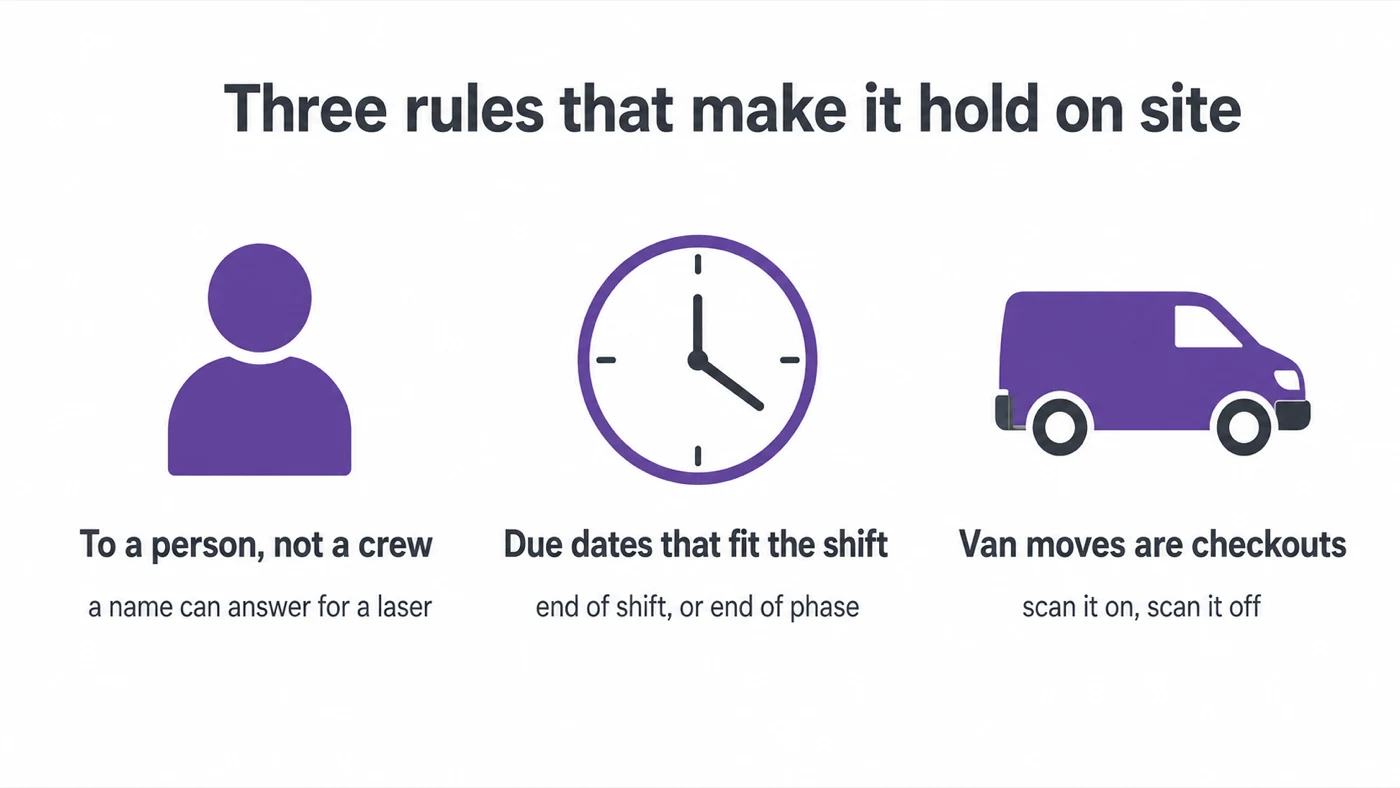
The loop is standard — scan, take, return — but three construction-specific choices decide whether it holds:
- Check out to people, not crews. "Team 2" can't answer for a rotary laser. A name can. This is the single most resisted and single most valuable rule; it stops being personal the day everyone's under the same rule and the reminders come from the system, not the foreman.
- Due dates that match site rhythm. Daily tools return end of shift; job-length loans return at phase end. The distinction matters because the overdue list is your early-warning radar, and if everything's due "sometime", nothing's ever overdue until it's gone.
- Between-site moves are checkouts too. The van run from site A to site B is where tools change custody without changing hands officially. Scan tools onto the van, scan them off. Two ten-second scans, and the eternal "it's at the other site" excuse becomes checkable.
Subcontractors: where loans go to die
Tools loaned to subs are the highest-loss category on most sites, because the hand-over is precisely where both accountability systems end. Tighten the defaults: checkout against the sub's named person (not the firm), condition photo at hand-over, a hard return date, and — the part that changes behaviour — the open-loans list reviewed at contract close, before final payment. Nothing in that is hostile; it's the same record that protects the sub from being blamed for the previous crew's chipped breaker. Loans with records get returned; loans without records get remembered differently by everyone involved.
Rolling it out without a mutiny
Tool tracking has a reputation on sites, and it's earned — most rollouts are announced as loss-prevention, which every worker correctly hears as we suspect you. The rollouts that stick flip the frame and the sequence:
- Start with the pain, not the policing. Launch on the tools crews fight over — the lasers, the breakers, the good drill. The first thing workers experience is being able to see who has the laser without three phone calls. That's a service, not surveillance.
- One container, one month. Prove the loop at a single store with a foreman who's bought in. Fix the label placements and due-date defaults there before scaling.
- Make the record visible both ways. Everyone can see their own checkouts. The same list that says what you owe also proves what you returned — say that out loud on day one.
- Then expand by store, not by memo. Vans next, subs after, small tools last (some never — a €12 hammer doesn't need a due date; a consumables bin with a restock trigger serves them better).
What comes out the other side isn't just fewer rebuys — it's the numbers the shrug never contained: which tools actually get used (and which idle capital to stop replacing), what breaks most, which sites eat batteries. The checkout record is the tool budget's first honest dataset.
The grinder will still get dusty, borrowed and argued over. But it'll be somebody's grinder, with a due date — and next year's shrinkage line gets a smaller shrug.
Frequently Asked Questions
-
The pattern that works on site is a labelled tool inventory, scan-based checkout from the container or van against a named worker, due dates or end-of-job returns, and automatic overdue reminders. The register and history live in one system readable from the office.
-
Yes, with placement and material chosen for it — laminated or metal-backed labels, on flat protected surfaces (battery housing, inside guards), plus the serial number recorded as backup. Labels on grips and wear surfaces die; labels in sheltered spots outlast the tool's service life.
-
Same process, stricter defaults — checkout against the subcontractor's named person, photo condition at hand-over, a hard return date, and the loan list reviewed at contract end before final payment. The record is what keeps it a loan instead of a transfer.