
Best Equipment Management Software? We Counted What 2,151 Comments Actually Recommend
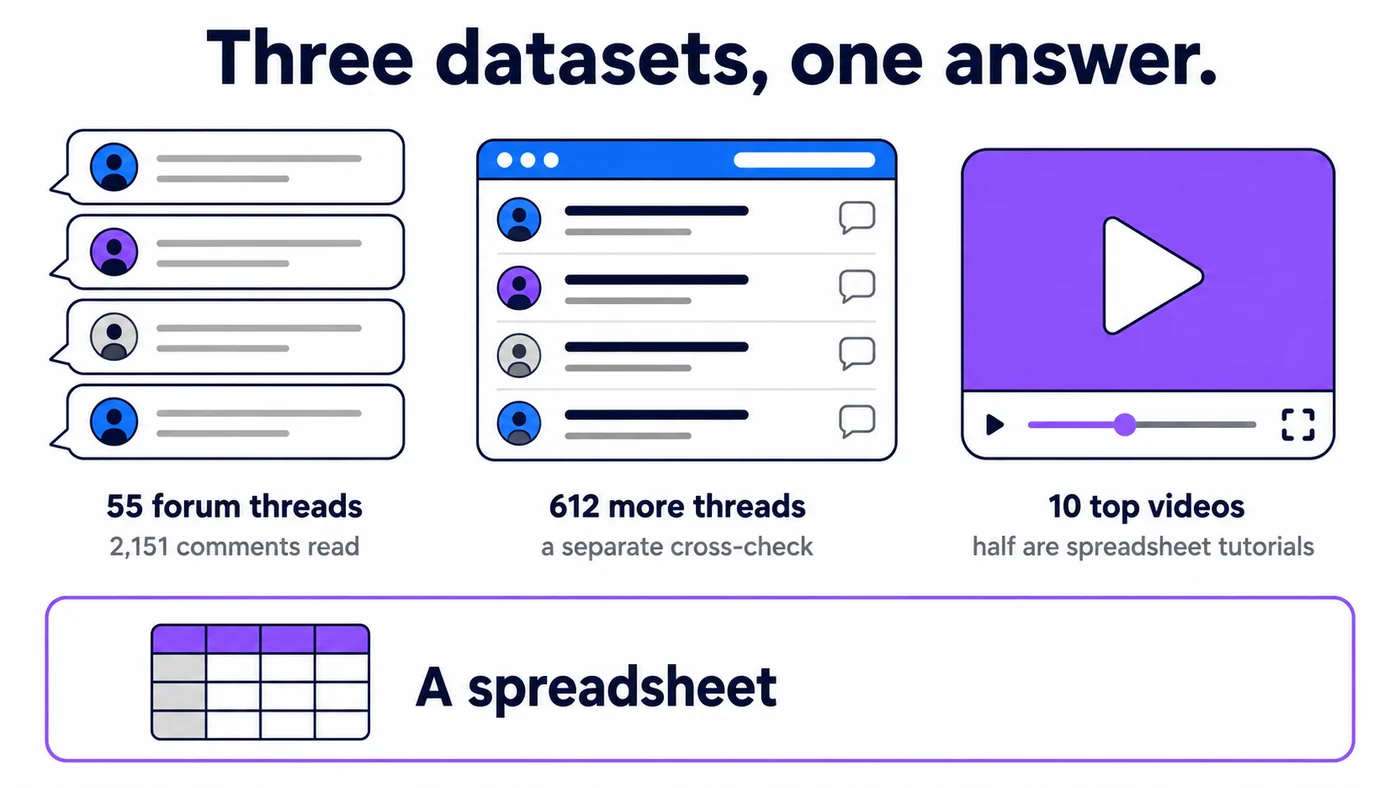
Every few weeks somebody asks the internet what to use for keeping track of shared equipment. We read the answers — 55 buying threads and 2,151 comments spanning nine years — and counted what people are actually told. The most recommended answer is not software.
The short version
- The most-recommended answer is a spreadsheet. It was named in 38 of 55 threads — more threads than any product in the category.
- There are two separate conversations that barely overlap: IT hardware registers, and shared gear that gets booked and taken out. Seven tools appear in the IT half and never once in the gear half.
- In the gear half nobody agrees. Across twelve threads, no tool was named more than four times. In the IT half, one tool appears in 33 of 43 threads.
- The busiest threads are not about software at all. The recurring genre is people not returning equipment — a process problem brought to a software forum.
In this article
- How we counted 2,151 comments
- The most recommended answer is a spreadsheet
- There are two conversations, and half of any list is aimed at the other one
- For shared gear nobody agrees — so popularity is a bad guide
- The busiest threads are about gear that never came back
- Four things we would do if we were choosing
- Method, and what not to read into this
Every few weeks, somebody posts a version of the same question. We have a room full of gear that people borrow. What should we use to keep track of it?
The answers to that question are scattered across a decade of forum threads, and nobody has ever counted them. So we did. We read 55 threads and 2,151 comments, posted between August 2017 and March 2026, and counted every tool named in every reply.
This is what people are actually told — not what vendors say, and not what the "best equipment management software" lists say. Some of it surprised us.
How we counted 2,151 comments
We searched Reddit for people asking what to use, filtered to threads where someone was genuinely shopping rather than announcing something, and kept the 55 with the most discussion. Then we pulled the full comment tree of each one and matched every product name mentioned in every comment.
The threads span twelve communities — system administrators, IT managers, small business owners, video engineers, theatre technicians, live sound engineers, commercial AV. As a cross-check we ran the same count against a separate capture of 612 Spiceworks and Hacker News threads.
A count of mentions is a blunt instrument, and we have written up its limits honestly at the bottom. But at this size the shape of the answer is clear.
The most recommended answer is a spreadsheet
A spreadsheet was named in 38 of the 55 threads, 137 times in total. That is more threads than any actual product in the category.
| Named in… | Threads (of 55) | Total mentions |
|---|---|---|
| A spreadsheet | 38 | 137 |
| Snipe-IT | 37 | 198 |
| Lansweeper | 26 | 92 |
| GLPI | 22 | 72 |
| AssetTiger | 18 | 31 |
| ServiceNow | 17 | 29 |
| Reftab | 16 | 21 |
| SharePoint / Microsoft | 14 | 34 |
| EZOfficeInventory | 13 | 17 |
| Notion / Airtable | 10 | 27 |
Snipe-IT carries more individual mentions — 198 against 137 — because when it comes up it tends to come up enthusiastically. But the spreadsheet appears in more separate conversations than anything else, which is the better measure of how widely an answer is held.
The cross-check agrees. In the 612 Spiceworks and Hacker News threads, a spreadsheet was named in 79 — again more than any named vendor. And it holds on a third surface: of the ten best-performing videos in this category on YouTube, five are tutorials teaching you to build the thing yourself in Excel or Google Sheets.
Three independent datasets, same answer. The category's market leader is a spreadsheet, and any honest discussion of this software has to start there.
We took that seriously enough to act on it. Itefy sells equipment management software, and we also publish a free equipment tracking spreadsheet — 500 items, no signup, runs in the browser, exports to Excel or CSV. A category whose most-recommended answer is a spreadsheet ought to be able to hand you one. Where it differs from a downloaded template is precisely the thing these threads complain about: checking something out sets the status and writes the log line in the same action, so the two cannot quietly drift apart. What it cannot do is chase anybody — and that boundary is what the rest of this article is about.
There are two conversations, and half of any list is aimed at the other one
This is the finding we would most want to know if we were the one asking the question, and it is invisible in every buyer's guide we have read.
Split the same 55 threads into the ones about IT hardware — laptops, monitors, phones issued to staff — and the ones about shared gear that gets booked, taken out and brought back. The recommendations barely intersect:
Seven of the tools above appear in the IT conversation a combined 111 times and never once in the gear conversation. Three others appear only in the gear conversation and never in the IT one.
That is not a coincidence of sampling. They are answers to different questions. Lansweeper and GLPI discover devices on a network. ServiceNow, Freshservice and Jira are service-management platforms where an asset is a ticket attachment. Those are excellent answers to "what hardware do we own and who is it issued to" — and no answer at all to "is the drone free on Saturday and did it come back".
The practical consequence: a list that names fifteen tools without splitting them is half irrelevant to you, and you cannot tell which half. If you run a theatre, a church AV team or a video department, roughly a third of every general "asset tracking" roundup is enterprise IT tooling that will never do what you need. Work out which conversation you are in before you read another list.
For shared gear nobody agrees — so popularity is a bad guide
In the IT threads there is a clear default. Snipe-IT appears in 33 of 43 — it is free, self-hostable, and the community reaches for it reflexively.
The gear threads have no equivalent. Across twelve threads, no tool was named more than four times. Some examples of what that looks like:
- A 33-comment thread in r/CommercialAV asking what inventory system companies use named exactly one product in the whole discussion.
- A 23-comment thread in r/smallbusiness about rental software named none at all.
- A 45-comment thread in r/techtheatre produced four different answers, one of which was a spreadsheet.
We went in expecting to find an incumbent we would have to argue against. There isn't one. For teams whose equipment gets booked and shared rather than issued and forgotten, this is a genuinely unconsolidated market — which is uncomfortable if you want a safe default recommendation, and useful if you are willing to evaluate on your own requirements instead of on popularity.
The busiest threads are about gear that never came back
The threads with the most replies and the most participants are not the "which tool should I buy" ones. They are a different genre entirely: people are not giving our equipment back.
From the Spiceworks capture, with view counts:
| Views | Replies | Thread |
|---|---|---|
| 4,553 | 41 | What's the "correct" process for people not giving back borrowed laptop chargers |
| 4,068 | 11 | Remote employee return equipment solution |
| 1,901 | 50 | Offboarding: Getting the Equipment Back! |
| 1,278 | 15 | How are you handling equipment returns in 2022? |
| 875 | 46 | Equipment Returns |
| 695 | 60 | Employees not returning equipment |
The same genre is the most active thing on the Reddit side too — a thread in r/ITManagers asking how people handle equipment not being returned drew 95 comments.
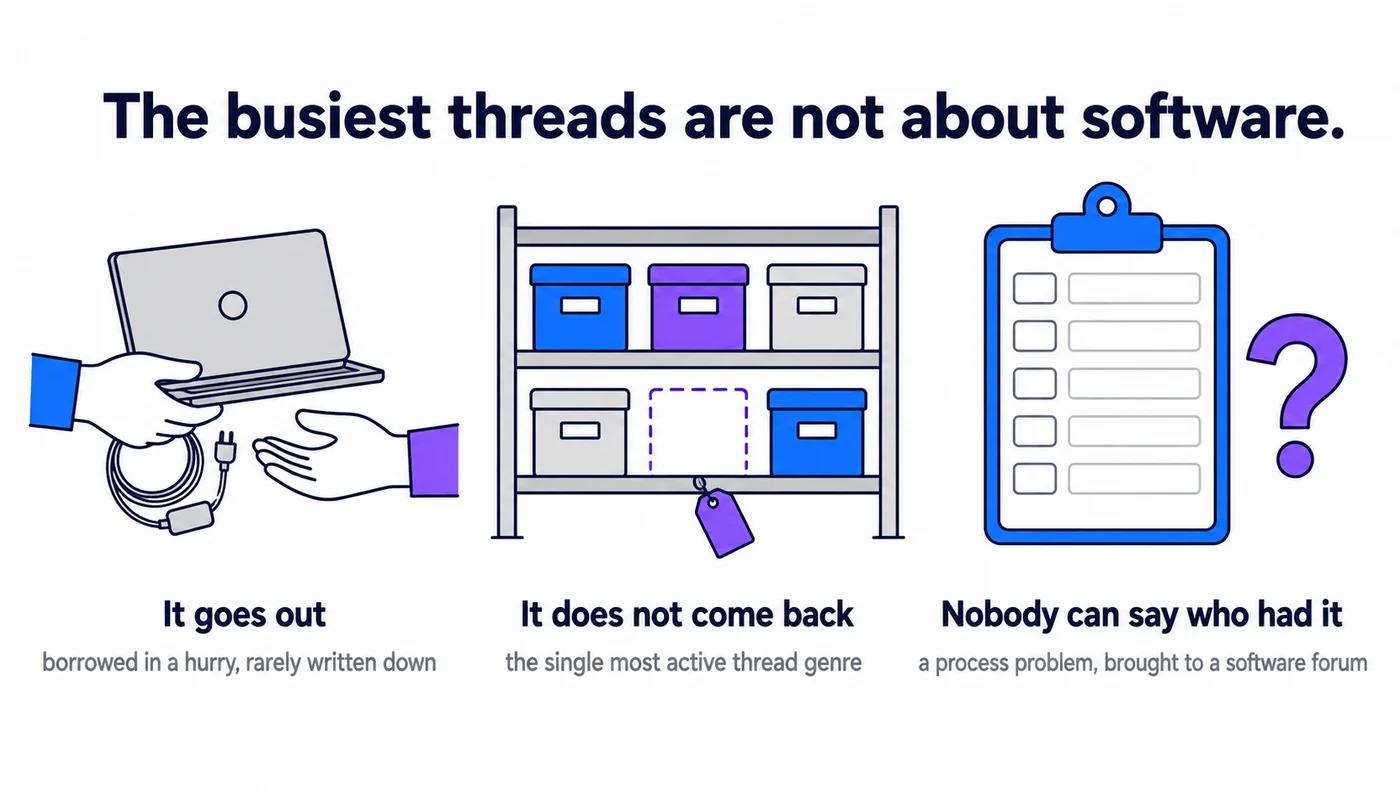
These threads recur every year, they draw far more participation than the product threads, and the answers in them are overwhelmingly process answers rather than product ones. People arrive at a software question carrying an accountability problem, and the software conversation mostly does not address it.
We think that is the most useful thing in this whole dataset, because it tells you what to actually test.
Four things we would do if we were choosing
Work out which conversation you are in, first. If your equipment is issued to a person and stays with them until they leave, you are in the IT conversation and the tools in the top half of that second table are aimed at you. If your equipment goes out on Tuesday and comes back on Thursday and somebody else wants it on Friday, you are in the other one, and most of that list will waste your time.
Take the spreadsheet answer seriously. It is the most common working answer in the category and it is not a mistake. It stops holding at three specific points: when several people need to edit it at once, when you need the current state of an item rather than a list of what exists, and when you need to reconstruct who had something six months ago. Until you hit one of those, the spreadsheet is genuinely fine — and if you want a decent one to start from, ours is free.
If you have just recognised yourself in one of those three, the thing to look for is not a bigger spreadsheet. It is something that records the current state and the history as a side effect of people doing the work — scanning a code, booking a slot, handing something back — rather than as a separate act of bookkeeping somebody has to remember to perform. That distinction is what survives a busy week; a tidier grid does not.
Ask every vendor the returns question. Given how dominant that thread genre is, it is remarkable how rarely a product demo covers it. Ask to see what an overdue item looks like, who gets told, and what the record looks like during an audit next year. It is a thirty-second question that sorts the category quickly.
Discount any list that does not split the two conversations. Now that you know they exist, you will notice that almost none of them do.
Method, and what not to read into this
We would rather you could check our work than take our word for it.
- The sample is 55 threads, not a census. They were chosen as the largest on-topic buying threads returned by 17 searches, filtered to threads with between 3 and 300 comments. Reddit's search relevance is loose, so treat every count as a floor.
- The IT/gear split is uneven. 43 IT threads against 12 gear threads, because the IT communities simply host more of these discussions. The direction of that finding is solid; the exact counts in the gear column rest on twelve threads and should be read as indicative.
- This counts mentions, not sentiment. A tool named four times might have been recommended four times or warned about four times. We counted names.
- Some name-matching is imprecise. Broad product names overlap with ordinary words, so a few counts are upper bounds rather than exact figures.
- Nine years is a long window. A recommendation from 2018 describes a product that has since changed. The recurring shape of the conversation is more reliable than any individual count.
The underlying capture — threads, comment counts, and the full tally of every tool named — was collected in August 2026.
Frequently Asked Questions
-
In the 55 buying threads we read, the most frequently recommended answer was not software at all — a spreadsheet was named in 38 of them. Among actual products, Snipe-IT was named in 37 threads and carried the most individual mentions (198), but almost entirely in IT hardware discussions. In threads about shared gear such as AV, theatre and live sound, no single tool was named more than four times.
-
Because two different questions are being asked under the same words. One group is tracking laptops, monitors and phones issued to staff, where the job is a register and an offboarding checklist. The other is tracking shared gear that gets booked, taken out and brought back. The tools that dominate the first conversation appear almost never in the second. A list that merges them will be half irrelevant whichever group you are in.
-
For a small team with one store and one person maintaining it, often yes — and it is the most common working answer in these threads. It stops holding when several people need to edit at once, when you need to know the current state of an item rather than a list of what exists, or when you need a record of who had something and when. Those are the limits people describe when they come back asking for something else.
-
Ask what happens when equipment does not come back. The single most active thread genre in this research is people chasing gear that was borrowed and never returned, and it is a question most product demos do not answer. Ask to see the overdue state, who gets notified, and what the record looks like six months later during an audit.
-
We searched Reddit for threads where someone asks what to use for tracking equipment, filtered to on-topic buying threads with between 3 and 300 comments, and read the full comment tree of the 55 largest — 2,151 comments in total, posted between August 2017 and March 2026. Every tool named in every comment was counted. We cross-checked the result against 612 Spiceworks and Hacker News threads captured separately. Full method and limitations are at the end of the article.