
Equipment sign-out sheets: a free template, and what yours needs to track
A sign-out sheet is the simplest accountability tool there is — one row per loan, signed and dated. Here is a template you can copy today, the seven columns that actually matter, and the point at which paper stops working.
In this article
- The template
- The seven columns, and why each one earns its place
- Rules that make it actually work
- When paper stops working
Every equipment room eventually invents the same document: a sheet by the door where people write down what they took. It's a genuinely good idea — the problem is almost never the idea, it's the execution. Half the sheets we've seen are missing the one column that would have settled last month's argument.
Here is a template that holds up, and the rules that keep it working.
The template
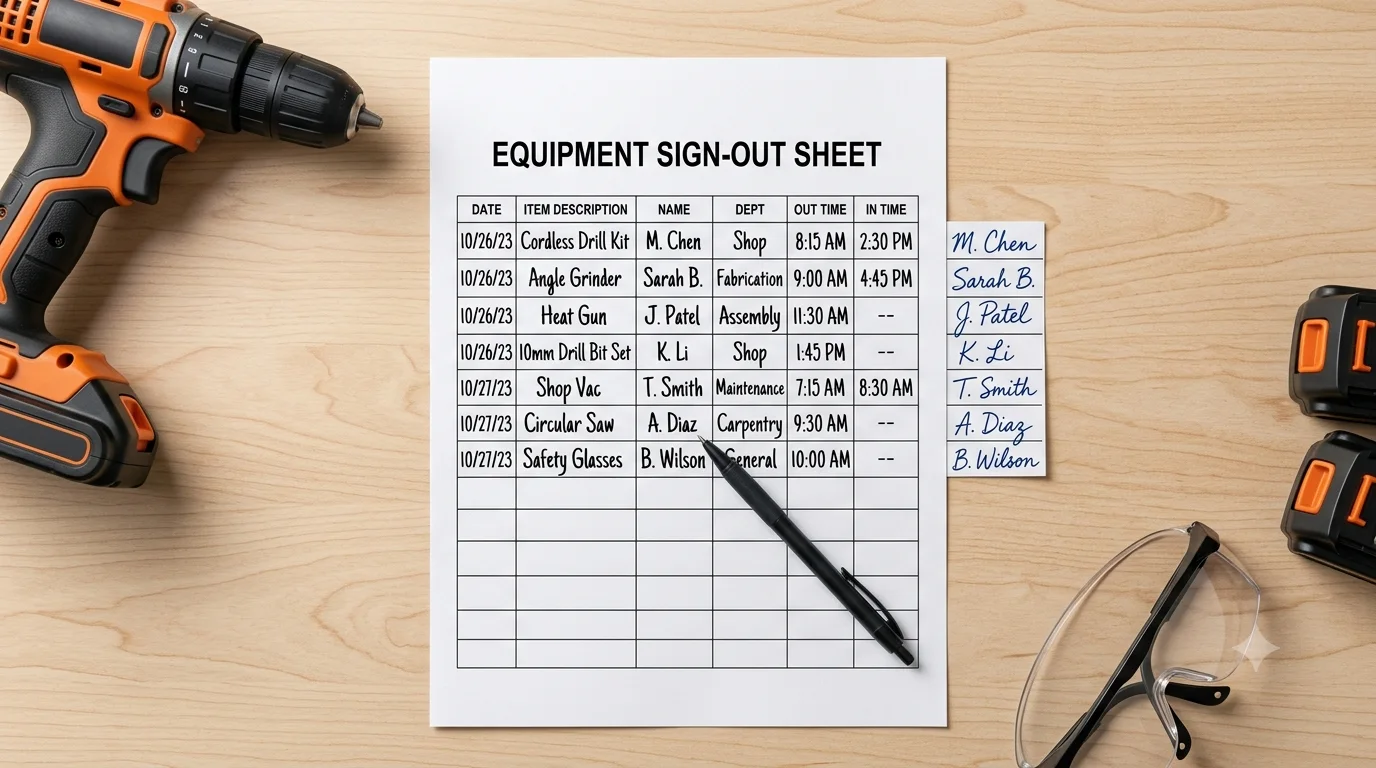
Copy this into a spreadsheet, or print it and put it on a clipboard where the equipment lives:
| Item | Item ID | Taken by | Date/time out | Due back | Date/time in | Condition on return | Initials |
|---|---|---|---|---|---|---|---|
| Cordless drill | T-014 | M. Berg | 3 Oct, 08:15 | 5 Oct | 4 Oct, 16:40 | OK | MB |
| Projector | AV-002 | K. Lund | 3 Oct, 09:00 | 3 Oct | — | — | KL |
If you'd rather start from a full equipment list with categories and details, our free equipment database spreadsheet pairs well with this sheet — one file is the register of what you own, the other is the log of where it currently is.
There is also a version with both in one place. Our free equipment tracking spreadsheet opens in the browser with no signup, and signing something out is one action on a row: it sets the status and writes the usage-log line together, so the register and the log can never tell you two different stories. Export it to Excel or CSV whenever you want the file — including an empty one, if a template is what you came for.
The seven columns, and why each one earns its place
- Item + item ID. "The drill" works until you own four. An ID — even just a number on a piece of tape — is what lets the sheet refer to one specific unit. If you label with QR codes, the ID is already on the item.
- Taken by. A name, not a team. "Site crew" cannot return your calls.
- Date and time out. The time matters more than people expect: two loans on the same day happen constantly, and sequence is what settles who had it when the damage happened.
- Due back. This is the column most homemade sheets skip, and it's the one that changes behaviour. A loan without a promised return date isn't a loan — it's a transfer of ownership nobody agreed to.
- Date and time in. Blank means it's still out. That simple rule turns the sheet into a live status board: scan the "in" column and everything blank is somewhere else.
- Condition on return. One word is enough — OK, damaged, needs charging. This is what makes the next borrower's complaint answerable, and it feeds your maintenance decisions.
- Initials. Signing something, even with two letters, measurably improves the truthfulness of the other columns. That's the whole psychology of the sheet.
Rules that make it actually work
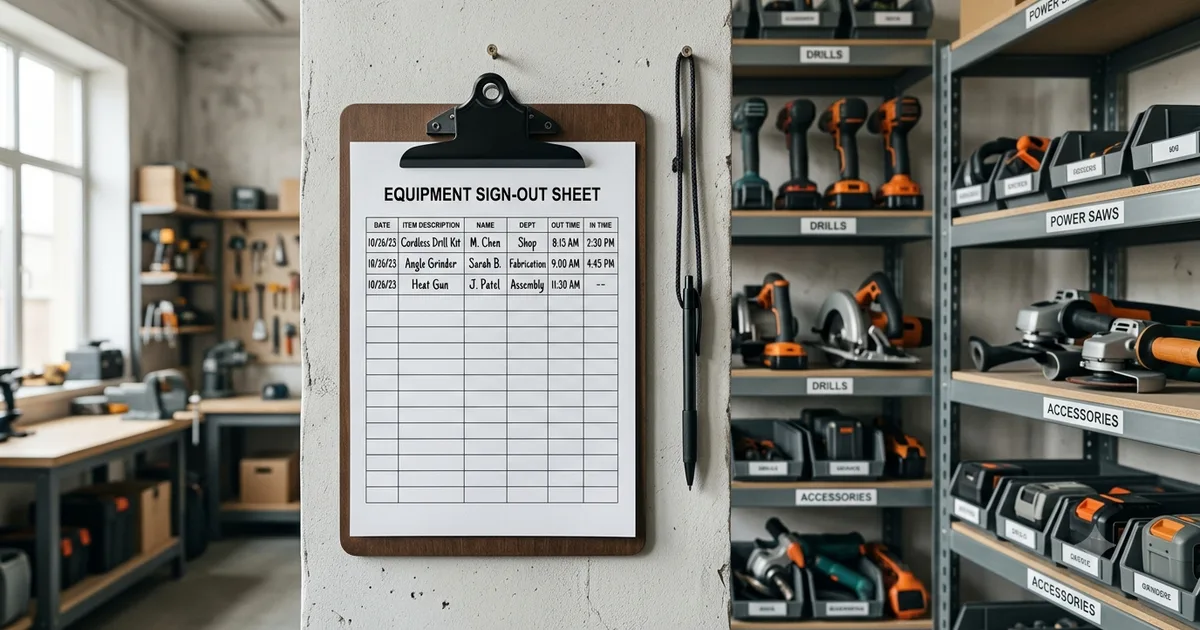
- The sheet lives where the equipment lives. Not in the office, not in a shared drive someone has to remember — at the shelf, with a pen attached by a string if that's what it takes.
- No exceptions for short loans. "I only had it for an hour" is how the sheet dies. If it leaves the shelf, it gets a row.
- One person owns follow-up. Once a week, someone scans the blank "in" column and chases what's overdue. A sheet nobody reads is theatre.
- Archive monthly, don't erase. Start a fresh page each month and keep the old ones. The history is the point — it's what you'll reach for when something turns up broken or doesn't turn up at all.
When paper stops working
A sign-out sheet has a natural ceiling, and you'll recognise it when you hit it:
- Someone promises the same projector to two people, because the sheet can't see next Thursday — it only records the present.
- Nobody can check status without walking to the shelf. The sheet is a single physical object; a remote crew or a second location can't read it.
- Chasing returns eats real time. Paper doesn't send reminders.
- The history is unsearchable. "How often did the generator go out last quarter?" means an afternoon with a stack of pages.
Those four failures have the same root: paper records loans but can't coordinate them. That's the point where teams move to an equipment checkout system — the same sign-out discipline, but with availability checked before anything is promised, reminders sent automatically, and every item's history kept without anyone maintaining a page. People scan a label with their phone instead of finding a pen, which — honestly — is also the first time the log becomes complete.
Until then: seven columns, a clipboard, and someone who reads the blank spaces once a week. It's more than most equipment rooms have.
Frequently Asked Questions
-
At minimum — item and its ID, who took it, the date and time out, the promised return date, the actual return date and time, condition notes on return, and a signature or initials. Everything else is optional; those seven columns are what settle disputes.
-
For a small team with one storage location and a handful of loans a week, yes — if it's enforced consistently. It breaks down when several people need to see the current status at once, when loans are booked ahead of time, or when the sheet's history needs to be searched.
-
A sign-out sheet records loans; a checkout system also enforces them. Software checks availability before something is promised twice, sends reminders when a return is overdue, and keeps the full history per item automatically.