
Truck and van maintenance checklist for small crews (with a printable service card)
Two vans, a pickup and a trailer, booked by whoever has the job. A daily walk-around a driver will actually do, and one service card per vehicle that survives the person who remembered.
In this article
- The daily walk-around: five things, two minutes
- Weekly and monthly
- The service card
- Faults, and the handover problem
- Where Itefy fits
Eight people, two vans, a pickup and a trailer. Whoever has the job takes whichever vehicle is free. The van's service is due "when someone remembers", the trailer's tyres were last looked at by a person who has since left, and last Tuesday a van failed on the way to a job because nobody knew the service was three months overdue.
Most vehicle maintenance checklists are written for haulage — air brakes, tachographs, DOT inspections, a monthly engine strip by a mechanic. If you run a handful of vehicles as work transport, that is not your reality and pretending otherwise means the list gets ignored entirely.
This is the small-crew version, plus a service card you can print.
The daily walk-around: five things, two minutes
The reason daily checklists fail is that they are too long. A twenty-item list gets ticked in the cab. Five items get looked at.
At key handover, or at the start of the day:
- Tyres — pressure by eye, and a look at the tread and sidewalls. Most roadside failures announce themselves here first.
- Lights — walk round with the hazards on. Ten seconds, and it is the thing that gets you stopped.
- Fluids — oil and coolant level, and a look underneath for anything wet on the ground.
- Damage — new dents, cracked glass, a mirror hanging. The point is to notice it now, not to attribute it.
- The load — is what should be in the van in the van, and is it secured.
Anything wrong goes on the vehicle's card, not into a conversation. That is the whole discipline.
Weekly and monthly
Weekly — screenwash topped up, wiper blades, spare tyre and jack present, first-aid kit and fire extinguisher present and in date, warning triangle.
Monthly — brake feel and any noises, battery terminals, belts and hoses looked at, an interior clean, and a check that the paperwork in the glovebox is current.
Neither of these needs a mechanic. Both are about ten minutes.
The service card
One per vehicle, and this is the part that survives staff turnover. Print it, keep it in the vehicle, and copy it into whatever central record you keep.
| Field | Notes |
|---|---|
| Vehicle | Make, model, registration, your own number |
| Driver / keeper | Who it is normally with |
| Service | Interval, last done, next due |
| MOT / annual inspection | Last, next due |
| Insurance | Renewal date |
| Tyres | Last replaced, which axle |
| Brakes | Last inspected |
| Cambelt or chain | Due at, done at |
| First aid kit | Expiry |
| Fire extinguisher | Service date |
| Trailer test / plating | Where applicable |
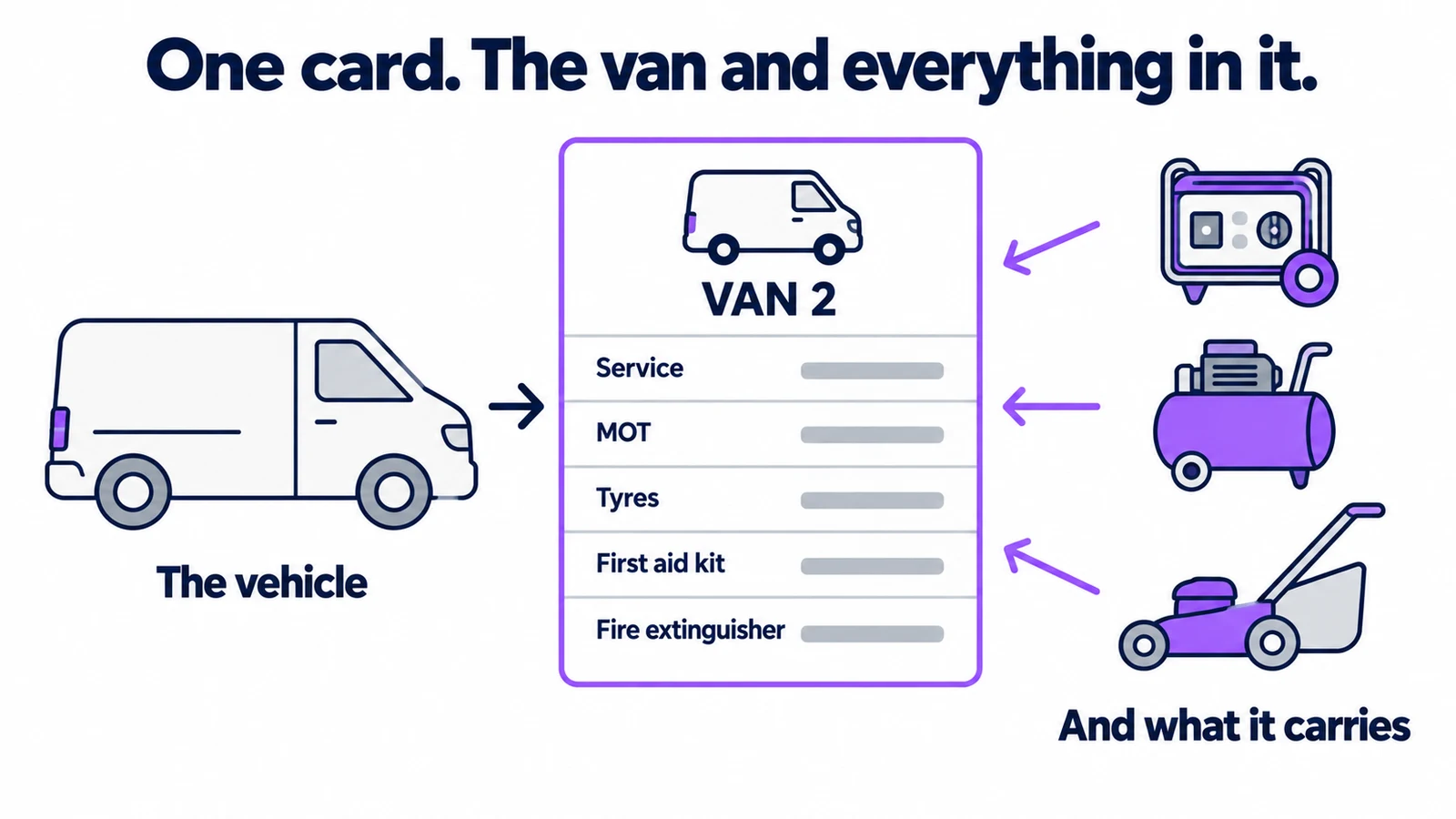
| Gear carried | Generator, compressor, mower — with their own service dates |
| Fault log | Date, what, reported by, resolved |
Two things about this card that are easy to get wrong.
Set intervals by date, not by odometer — unless you have something reading the odometer for you. A date can have a reminder attached to it; a mileage figure requires somebody to go and look. Work out roughly what mileage the vehicle does in a year and convert the manufacturer's interval into months.
Put the gear inside the vehicle on the same card. The generator in van 2 has a service interval and nothing forces the issue the way an MOT does, so it is the thing that gets skipped for three years. Somebody keeping service logs for vans and mowers and generators together is the normal shape of this job, and splitting them across two systems is how one of them gets dropped.
Faults, and the handover problem
The single most common way a small crew ends up with a vehicle off the road is that somebody noticed something and told a person rather than the record.
- A fault reported to a colleague dies when that colleague is off.
- A fault written on the vehicle's card is seen by the next driver.
- A fault that makes the vehicle unsafe has to take it out of use now, not at the end of the week.
Handover is the moment to catch this: the person taking the keys does the two-minute walk-around, and anything they find is recorded before they drive. It also settles the "it was like that when I got it" conversation, permanently, in both directions.
Where Itefy fits
The card works on paper and if paper is working, keep it. Software helps where paper reliably fails: remembering the dates, and being readable by the person who is not in the yard.
In Itefy a vehicle is an item like any other. It carries recurring maintenance on a calendar with reminders before each service, MOT or inspection falls due, and the generator, compressor and mower that live in it are items too, on their own intervals — so the things with no legal deadline get chased the same way as the things that have one.
The vehicle can be checked out to a named driver with a return time, which is the handover record. Anyone can report a fault from their phone with a photo, and a vehicle marked inoperative is refused for the next booking until somebody signs it off, so a van with a brake problem cannot quietly be taken out again on Monday.
The honest caveat, and it decides whether this fits your process: intervals are by date, not by distance. There is no telematics, no GPS, no odometer capture, no fuel cards, no driver-hours or tachograph handling, and no DVIR workflow. Nothing is read from the vehicle. If your maintenance plan is driven by mileage readings, Itefy will not trigger from them, and that is the gap to test before anything else — see what Itefy does and does not do for transport.
There is a 14-day free trial with no card.
Frequently Asked Questions
-
Two minutes. A twenty-item daily list is a list that gets ticked in the cab without anybody looking at the vehicle. Five things, done properly, catch more than twenty things done nominally.
-
Both, in an ideal world — but if you are tracking this by hand, dates are what actually get followed, because a date can have a reminder attached and an odometer reading cannot. Set the date interval from the mileage you expect the vehicle to do.
-
Put it on the same card. The generator, the mower, the compressor and the transformer all have service intervals too, and they are the ones that get forgotten because they have no MOT to force the issue.