
Tool crib management: from pegboard chaos to a system that gives tools back
A tool crib has one job — hand tools out fast and get them back complete. Here's how to organise the room, decide between open access and gatekeeping, and run a checkout process that survives the 06:45 rush.
In this article
- Decision 1: Give every tool an address
- Decision 2: Attended, open, or scan-out?
- Decision 3: Returns are a process, not a hope
- The three numbers a crib manager should glance at weekly
Walk into a well-run tool crib and you can feel it: tools have addresses, the 06:45 rush moves in seconds per person, and the crib attendant — if there is one — spends their time on maintenance, not interrogations. Walk into the other kind and you'll find the shadow board with four silhouettes and no tools, the drawer of dead batteries, and a foreman who buys duplicates because looking costs more than buying.
The difference is rarely money. It's three decisions, made deliberately: give every tool an address, choose your access model on purpose, and make returns a process instead of a hope. This guide walks through all three, plus the weekly numbers that tell you whether the crib is actually working.
Decision 1: Give every tool an address
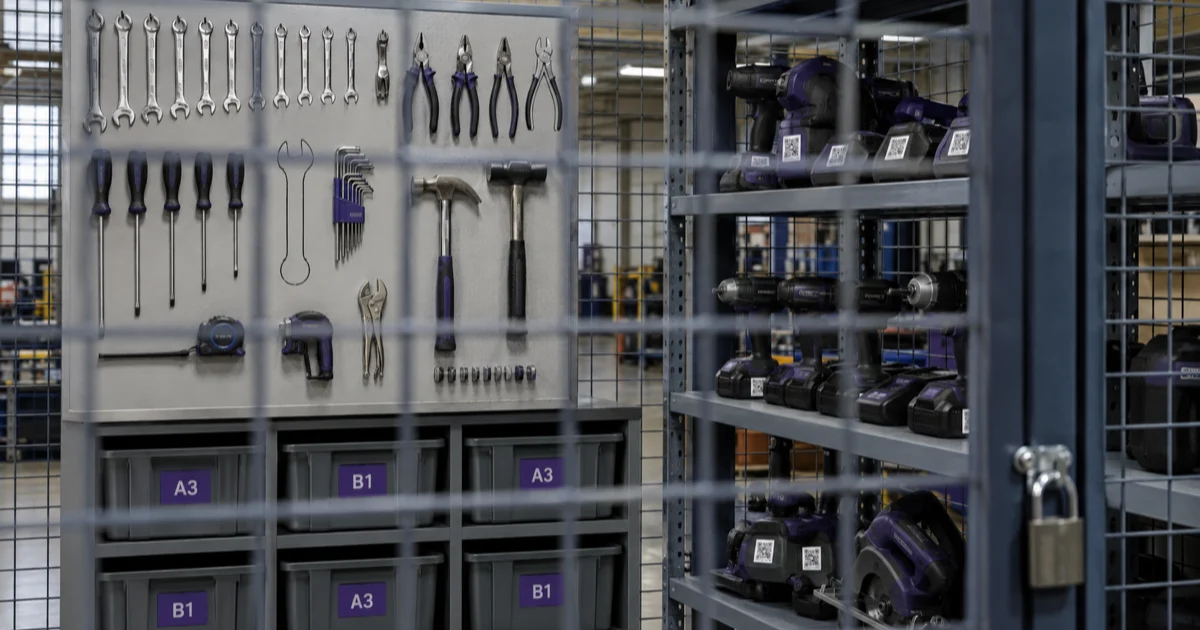
A crib is a tiny warehouse, and warehouses work because everything has a location. Zone the room by trade or task — power tools, measuring, lifting, consumables — then give shelves and bins short codes (A3, B1). A tool's home gets written on the bin and attached to the tool's record, so "where does this go?" never needs a veteran's memory.
Two details pay for themselves:
- Shadow boards for the top twenty. The most-borrowed tools get outlined spots; an empty silhouette at day's end is an instant, walk-past audit.
- Kit thinking for jobs, not just tools. If the torque-testing job always needs the same five items, store and issue them as a named kit. Half of "missing" tools are actually complete kits missing one part.
Decision 2: Attended, open, or scan-out?
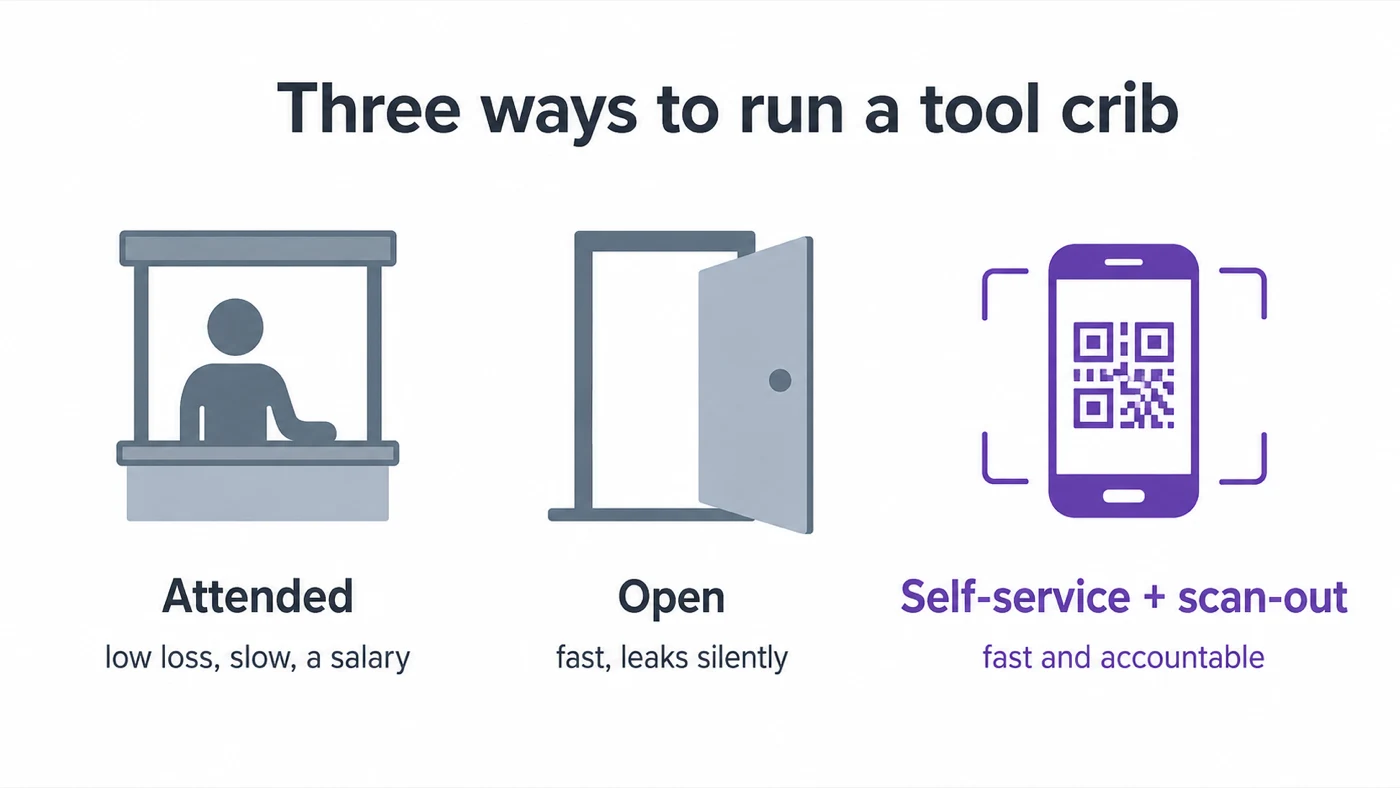
The classic trade-off: an attended crib (a person issues everything) loses very little but costs a salary and queues at shift start. An open crib (take what you need) is fast and free — and slowly bleeds tools, because nothing records who took what. Most yards oscillate between the two, tightening after a bad month of losses, loosening when the queue gets political.
There's a third option that has quietly become the default for mid-sized operations: self-service with scan-out. Every tool carries a QR label; taking one means scanning it with your phone and confirming — five seconds, no attendant. The crib stays open and accountable: every tool that's out is out against a name, with a timestamp and an expected return.
The honest precondition: scanning must be genuinely faster than sneaking. Phone app, no login friction at the shelf, label placed where the hand already is. If recording a checkout takes 45 seconds, your open crib is back within a month.
How the three models actually compare:
| Attended crib | Open crib | Self-service + scan-out | |
|---|---|---|---|
| Issue speed | Slow — queues at shift start | Instant | Seconds per tool |
| Loss rate | Lowest | Highest, and invisible | Low — every loan has a name |
| Staffing cost | A salary | None | None |
| Usage data | If the attendant logs it | None | Automatic |
| Weak spot | The queue gets political | Nothing records anything | Dies if scanning is slow |
Most cribs that "tried tracking and it didn't stick" actually tried the attended model's paperwork with the open model's staffing — a logbook nobody enforces. Scan-out is the version where the recording does itself.
Decision 3: Returns are a process, not a hope
Issues take care of themselves — people come to the crib because they need something. Returns have no such motive force, so they need mechanics:
- Every issue gets a due date, even if it's just "end of shift". An open-ended loan is a donation.
- Overdue means a reminder, automatically. The checkout system chases; humans only escalate. This single change removes the crib's worst social friction.
- Returns get a condition word. OK / damaged / needs service, one tap. Damaged tools route to a repair queue instead of returning to the shelf as a trap for the next borrower — that's the link between the crib and your maintenance program.
- Batteries and consumables have their own rule. Chargers live in the crib, packs get numbered, and drill bits and blades are tracked as consumable inventory with a low-stock alert — not as tools with due dates.
The three numbers a crib manager should glance at weekly
- What's overdue, by person. Not to punish — to spot the patterns worth a conversation.
- What never comes off the shelf. A tool unused for a year is capital pretending to be readiness. Sell it or move it to the site that needs it.
- What breaks most. Frequency of damage per tool model tells you what to stop buying, and per person tells you who needs ten minutes of training.
None of these are readable from a pegboard. They fall out for free once issues and returns are recorded — which is the quiet, compounding argument for scan-out over silhouettes: the same five seconds that protects the tool also writes the data that runs the crib. If you're weighing up systems, our overview of tool and equipment management covers what to look for; if you're still at the spreadsheet stage, start with the free equipment database template and graduate when the sheet stops keeping up.
Address, access model, return mechanics. Get those three right and the crib runs itself — and the silhouettes on the shadow board go back to being decoration.
Frequently Asked Questions
-
A controlled storage area — a room, cage or container — where a company's shared tools and equipment are kept, issued to workers, and returned. The name comes from manufacturing, but every construction yard, maintenance department and workshop runs one, whether they use the word or not.
-
Attended cribs lose less but cost a salary and create queues; self-service cribs are fast and cheap but leak unless every hand-over is recorded. The modern middle ground is self-service with scan-out — open access, but taking a tool requires scanning its label, so accountability survives without a gatekeeper.
-
Label every tool with a durable ID (QR or barcode), record each issue and return against a person, and set expected return dates. Software makes the record automatic at scan time and flags what's overdue.