
How to migrate Excel equipment lists to Itefy
Microsoft Excel, Google Sheets and other spreadsheet software are great to get started with equipment management. But when limitations arise, you may consider a dedicated equipment management system. Here is how to know when it's time, what transfers and what doesn't, and how to make the move in an afternoon.
In this article:
- Five signs you've outgrown the spreadsheet
- What transfers, and what doesn't
- Step 1 — Twenty minutes of spreadsheet prep
- Step 2 — The import, in three steps
- Step 3 — Spot-check before you trust it
- Step 4 — Fix mistakes in bulk, not one by one
- Step 5 — Do the one thing a spreadsheet never could
- How long this actually takes
- Run both for a week
Spreadsheets are versatile tools, and they get used for plenty of things they were never designed for. Equipment management is one of the most common. A sheet with a row per item, a column for who has it and a tab per location will carry a small team a surprisingly long way — and moving spreadsheets into the cloud has made them genuinely collaborative.
So this article is not an argument that spreadsheets are bad. It's about what to do at the point where yours has stopped paying its way — how to tell you've reached it, what actually transfers, and how to move a register into Itefy without losing a weekend.
Five signs you've outgrown the spreadsheet
Not "you should use software because software". These are the specific failures that show up in equipment sheets, and none of them are fixable with a better formula:
- You've started asking people where things are. The sheet says a projector is in Meeting Room 2. It isn't. Nobody updated the cell when they moved it, because updating a cell is a separate act of goodwill from moving the projector.
- Nothing is overdue, because nothing can be. A spreadsheet holds a due date. It cannot notice the date has passed, and it cannot tell the person holding the item. Chasing is manual, so it happens late or not at all.
- Two people booked the same kit. Availability in a sheet is a human reading rows and drawing a conclusion. It works until two people read it at once.
- You can see now, but not then. Current state overwrites history. When you want to know how often a machine was used last quarter, or when it was last serviced, the sheet has the answer only if someone kept a parallel log.
- One person keeps it alive. There is a version that matters and a person who maintains it. When they're on holiday the register quietly goes stale, and when they leave it goes stale permanently.
If you recognise one of these, a spreadsheet is still fine. If you recognise three, the sheet has become the thing you manage instead of the equipment.
What transfers, and what doesn't
Worth being clear about this before you start, because it sets expectations for the whole project.
Transfers cleanly: the items themselves and their attributes — names, unique IDs, types, locations, condition, purchase and expiry dates, purchase and salvage values, even a main image per item if you have image URLs.
Does not transfer: history. Past checkouts, old reservations and previous maintenance records don't come across, because in a spreadsheet they usually aren't structured records in the first place — they're notes in a cell or rows on another tab.
That sounds worse than it is. Equipment history is only useful going forward: you want to know this machine's service record from the point you started tracking it properly. Keep the old sheet as a read-only archive for the rare backwards question, and let the real history start accumulating from your go-live date.
Step 1 — Twenty minutes of spreadsheet prep
Time spent here is the difference between an import that maps itself and an hour of fixing dropdowns. Two rules:
One row per item. Merged cells, blank spacer rows and a summary block at the bottom all have to be unpicked later. If you have a tab per location, consider consolidating into one sheet with a location column.
Name your columns so Itefy recognises them. This is the part that does the work — if the first row contains a name Itefy knows, it assigns the field automatically. The names worth using:
- Name — the item name. This is the only column that must be mapped.
- Unique ID — licence plate, serial or asset number
- Type — Vehicle, Camera, Laptop, and so on
- Home Location and Current Location — where it lives when idle, and where it is now
- PPR or Person Responsible — the person accountable for the item
- Condition — must be Operative, Inoperative or Discarded; other values are ignored
- Purchase date and Expiry date (Acquisition date / Expiration date also work)
- Purchase value and Salvage value — in your account's currency
- ImageURL — a complete
http://orhttps://URL to a main picture, under 10 MB
Then save or export as .xlsx, .xls or .csv. Google Sheets and Apple Numbers both export these — there's no live Google Sheets connection, so export first.
Starting from nothing, or want a sheet that's already shaped correctly? Take our free equipment tracking spreadsheet template — its columns are already named the way the importer expects, so it maps in one pass.
Step 2 — The import, in three steps
In the main menu choose Items > Add item, then Import from spreadsheet. The wizard has three steps.
Upload. Select or drag in your file. It takes a second or two.
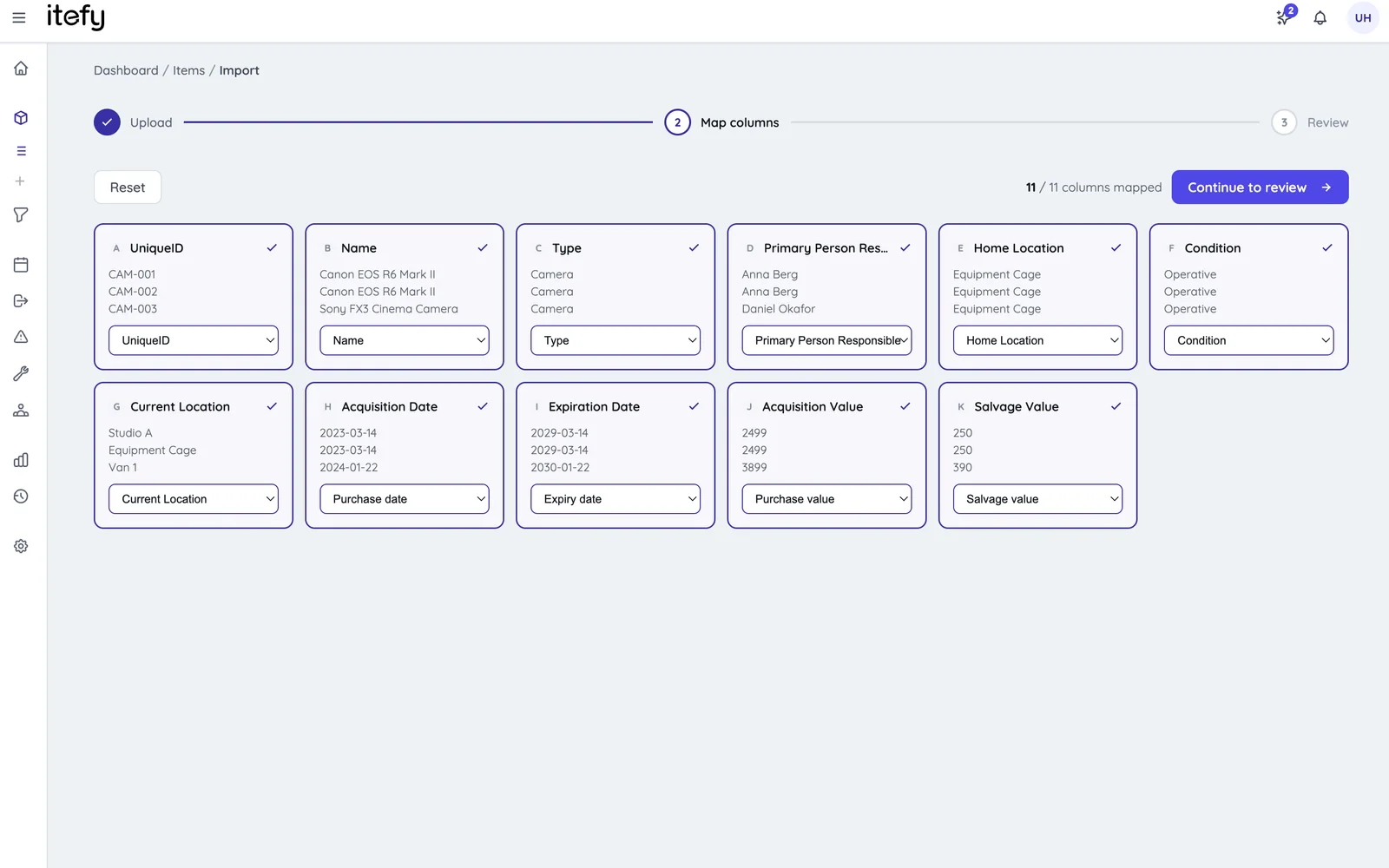
Map columns. If the workbook has several sheets, pick the right one in the Sheet dropdown first — this is the single most common thing people get wrong. Then check the field assigned to each column, correct any that guessed wrong, and set None (skip column) for columns you don't want. You can't continue until Name is mapped.
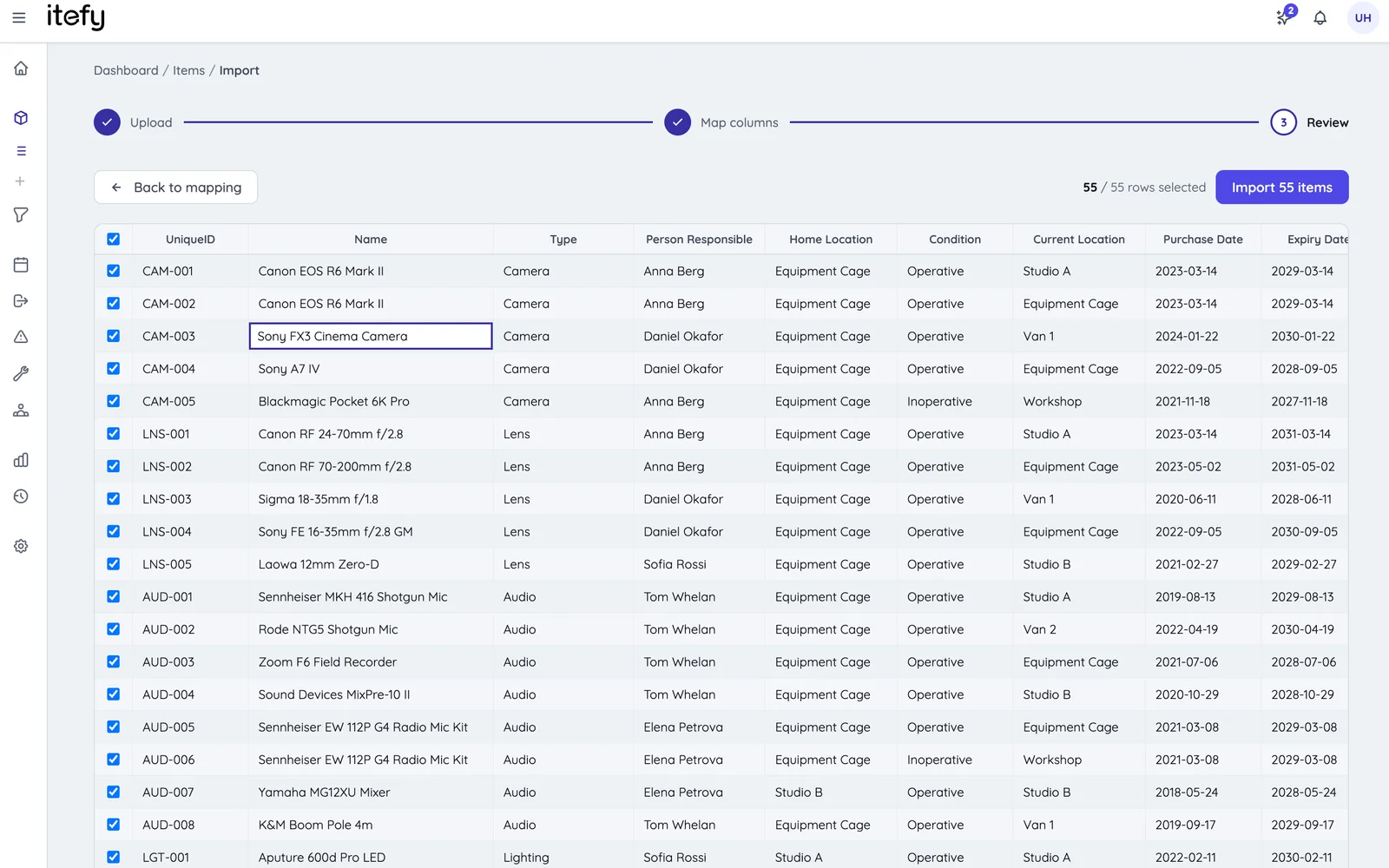
Review. You get the whole grid before anything is written. Uncheck rows you don't want. Click any cell to fix its text right there — worth doing for the handful of typos you'll spot, rather than going back to Excel. Then click Import … items.
You'll get a summary when it finishes, and can either import another file or go straight to the items list. A few hundred items takes minutes, and replaces hours of retyping.
Five things that catch people out
- Locations are created automatically if they don't exist. Convenient — but it means
Warehouse,warehouseandWharehousebecome three separate locations. Spell-check that column before importing. - Person Responsible only applies if that user already exists. If you haven't invited your team yet, the column is silently ignored. Invite people first, or plan to set responsibility later.
- The first row is treated as column names and comes unchecked. If your sheet has no header row, just check row 1 in the Review step to import it.
- Importing twice creates duplicates. There's no matching against existing items. Import once.
- Your item quota is the ceiling. If the register is bigger than your plan allows, raise the quota under Settings > Subscription first.
The step-by-step import tutorial in the Help Center covers all of this in more detail, and the import reference lists every mappable field.
Step 3 — Spot-check before you trust it
Don't declare victory on the summary screen. Three checks, five minutes:
- Open a few items you know well. Search for them by name and confirm the type, location and values landed where you expected.
- Open the type and location filters. This is where import problems become visible — a stray location or a type you've never heard of means a typo made it through.
- Check the count. Does the number of items match the rows you imported?
Step 4 — Fix mistakes in bulk, not one by one
If a whole group needs the same correction — a missing type, a location that imported wrong — don't open items individually. Select them and use Edit selected, or search/filter and use Edit results, which applies to everything matching your search including rows on other pages.
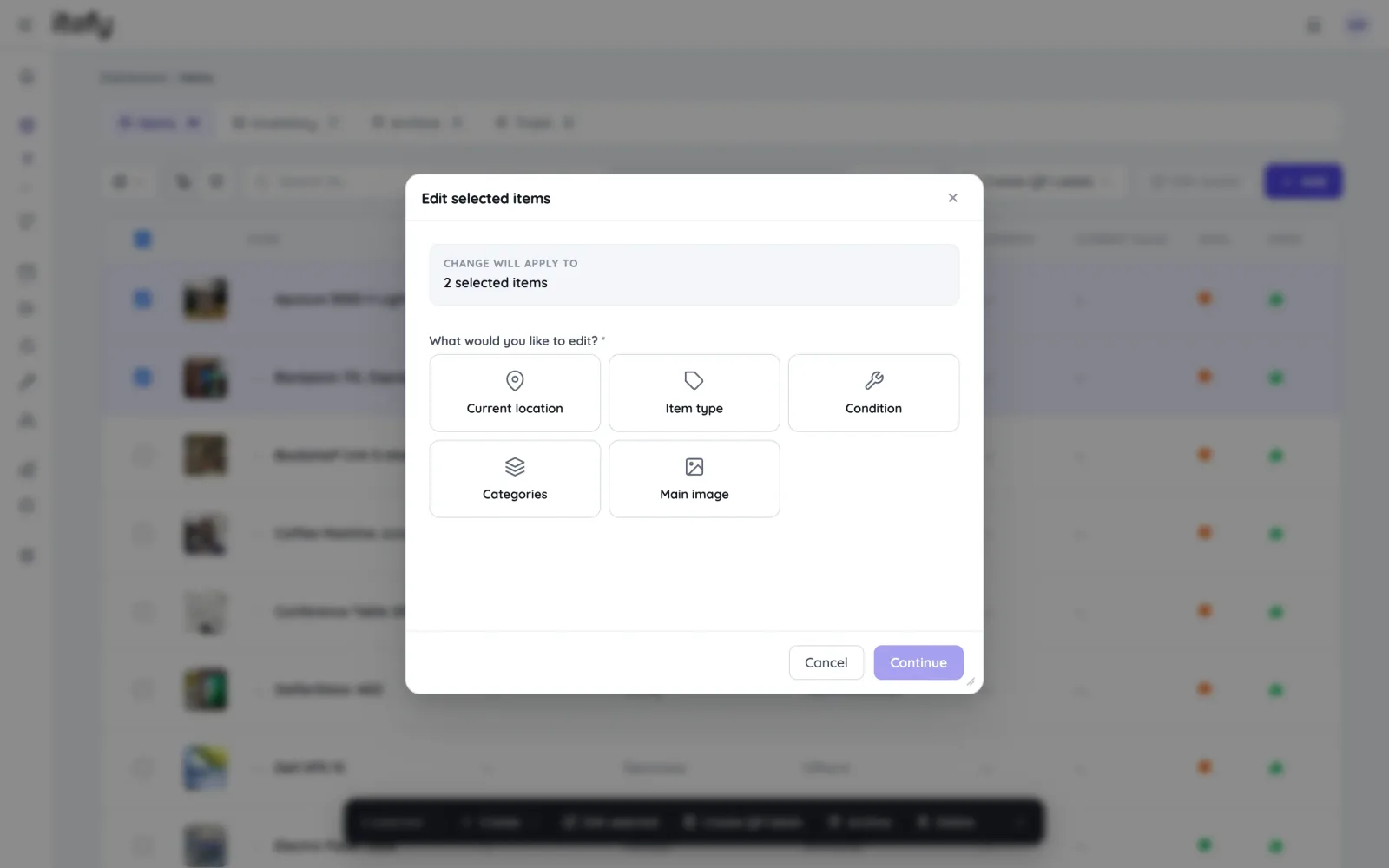
You can batch-change Current location, Item type, Condition, Categories or Main image. You get a summary before it runs and a receipt afterwards showing what changed and anything that failed.
Step 5 — Do the one thing a spreadsheet never could
At this point you have your register in a database instead of a grid. The migration isn't finished until you've turned on the part that fixes the five problems at the top of this article: labels on the physical equipment.
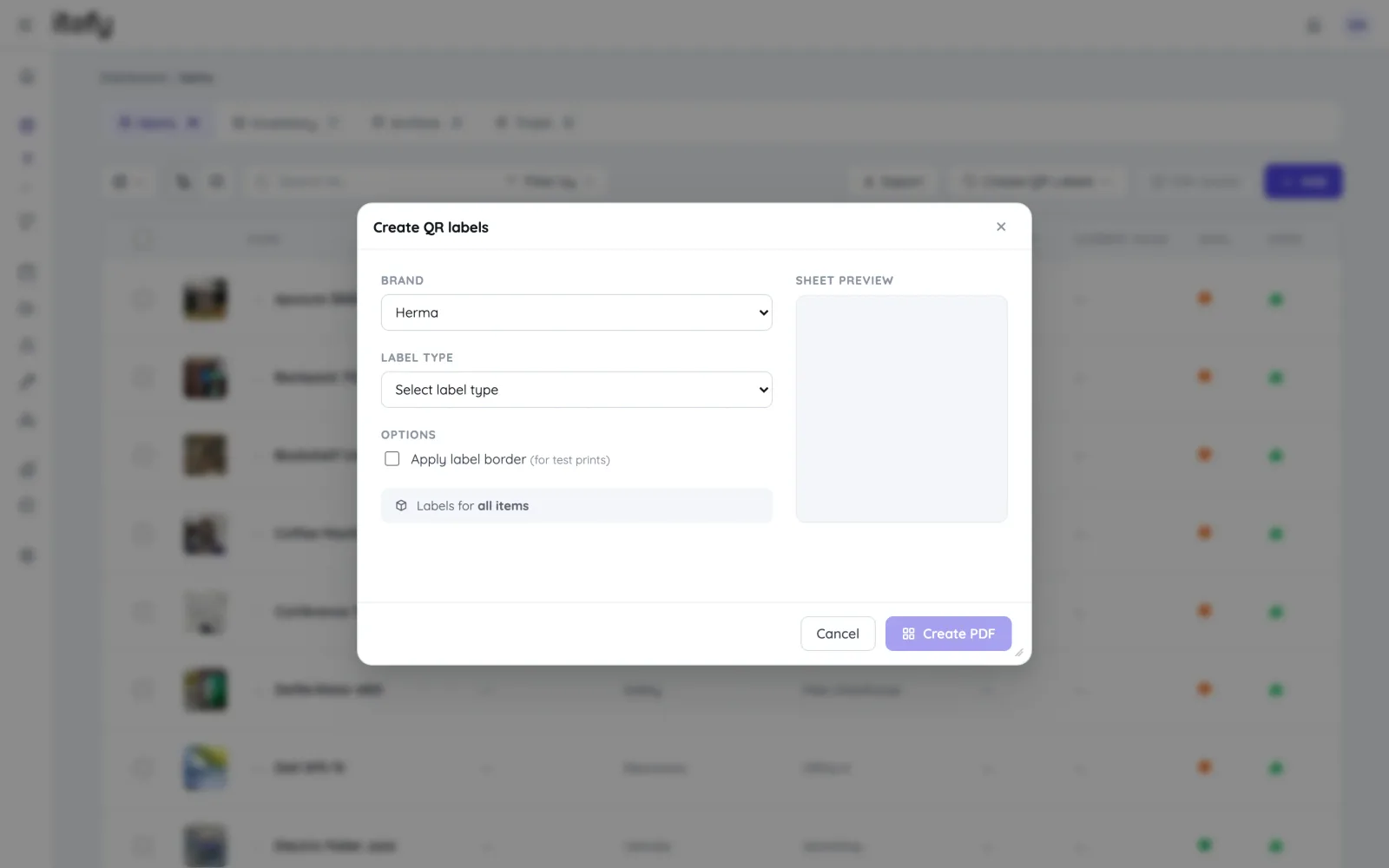
Pick your label-sheet brand and type, and Itefy generates a print-ready PDF for every item you just imported. Stick them on. From then on, anyone with a phone can scan an item to see what it is, check it out or back in, report a fault or change its location — without finding you, and without finding the spreadsheet.
Then set up the routines the sheet couldn't hold: reservations so two people stop booking the same kit, and maintenance schedules so servicing stops depending on memory.
How long this actually takes
For a register of a few hundred items, on a sheet that's in reasonable shape:
- Spreadsheet prep — 20 minutes
- The import itself — 5 minutes
- Spot-check and batch fixes — 30 minutes
- Printing and applying QR labels — an afternoon, and the only part that scales with how much equipment you own
The data migration is genuinely a morning's work. Labelling the gear and building the habit is the real project, and it's worth sequencing deliberately: import first, label second, then switch the team over.
Run both for a week
Resist deleting the spreadsheet on day one. Make it read-only, tell people the register lives in Itefy now, and give it a week or two. You'll find the two or three columns you actually relied on that nobody mentioned, and you'll want the old sheet while you sort them out.
Once people are reaching for Itefy by habit rather than instruction, archive the sheet. That's the point the migration is finished — not the moment the import succeeds.
Ready to try it? Start a free 14-day trial — no credit card, no setup fee — and import your existing sheet in the first ten minutes.
Frequently Asked Questions
-
Not as a live Google Sheet — export it as .xlsx or .csv first (File > Download in Google Sheets), then upload that file. Apple Numbers and most other spreadsheet software can export the same formats.
-
No. The import creates equipment items with their attributes; it does not create historical checkouts, reservations or maintenance records. Keep the old spreadsheet as a read-only archive, and let the new history build from your go-live date.
-
You get duplicate items — the import does not match against existing ones. Import once, verify, and if something went wrong delete or archive the batch before re-importing.
-
As many as your plan's item quota allows. If your register is larger than your current quota, raise it under Settings > Subscription before importing.
-
No, and most teams shouldn't. Run both for a week or two with the spreadsheet read-only, then retire it once people are reaching for Itefy by habit.