
The university gear room on a small-department budget
Film, journalism, music and science departments all run the same operation — a room of expensive equipment lent to a rotating population of students — usually on a budget that rules out enterprise checkout platforms. Here's the lean version that still works.
In this article
- What a gear room actually needs
- Kits are the difference between theory and Friday afternoon
- Rules that survive a student population
- Surviving turnover — the quiet killer
Every campus has these rooms: the film department's cage of cameras and lenses, the journalism school's audio shelf, the biology lab's field kit store, the music department's instrument closet. Same operation everywhere — expensive, fragile, in-demand equipment, lent in high volume to borrowers who are enthusiastic, broke, and gone in three years.
The university-wide answer to this is enterprise checkout platforms, priced accordingly — and if your institution has one and your department is covered, use it. This article is for the other case, which is most cases: a single department, a gear room run by one staff member and a rota of student assistants, and a budget where software competes with replacing a lens.
What a gear room actually needs
Strip away the enterprise feature lists and the difference between "department tool" and "institutional platform" becomes concrete:
| A department gear room needs | Enterprise platforms add | |
|---|---|---|
| Booking | Conflict-checked reservations per item/kit | Cross-campus patron portals |
| Access rules | Rights per course, blocks on overdue | LMS/SIS integrations, enrolment sync |
| Accountability | History per item and borrower, condition photos | Fine ledgers, bursar billing integration |
| Admin | One coordinator + student assistants | Dedicated system administrators |
| Budget | A course-budget line item | An institutional procurement |
If you need the right-hand column, buy it. Most departments only ever use the left — and the left is a four-step loop:
- Booking ahead for anything contested. Students plan shoots; two productions wanting the good camera on the same weekend is the normal case, not the edge case. Bookings need conflict checking at booking time — the collision must surface while there's still time to replan the shoot, not at the counter on Friday.
- Checkout at the counter that takes seconds. Pickup rushes cluster before classes and weekends; the student assistant scans the QR label on each item — or the whole kit — against the borrower, and the queue moves. Slow checkout doesn't just annoy; it creates pressure to skip recording, and skipped records are how gear rooms leak.
- Due dates in days, reminders by robot. Weekend loans, three-day loans, term project loans — all fine, as long as return dates exist and the chasing is automated. A student assistant should never be the one personally nagging a peer; that's a social tax the checkout system should pay instead.
- History per item and per borrower. The lens comes back decentered — who had it, in what order? The student disputes a damage charge — what did the checkout photo show? History converts every hard conversation from testimony to record.
Kits are the difference between theory and Friday afternoon
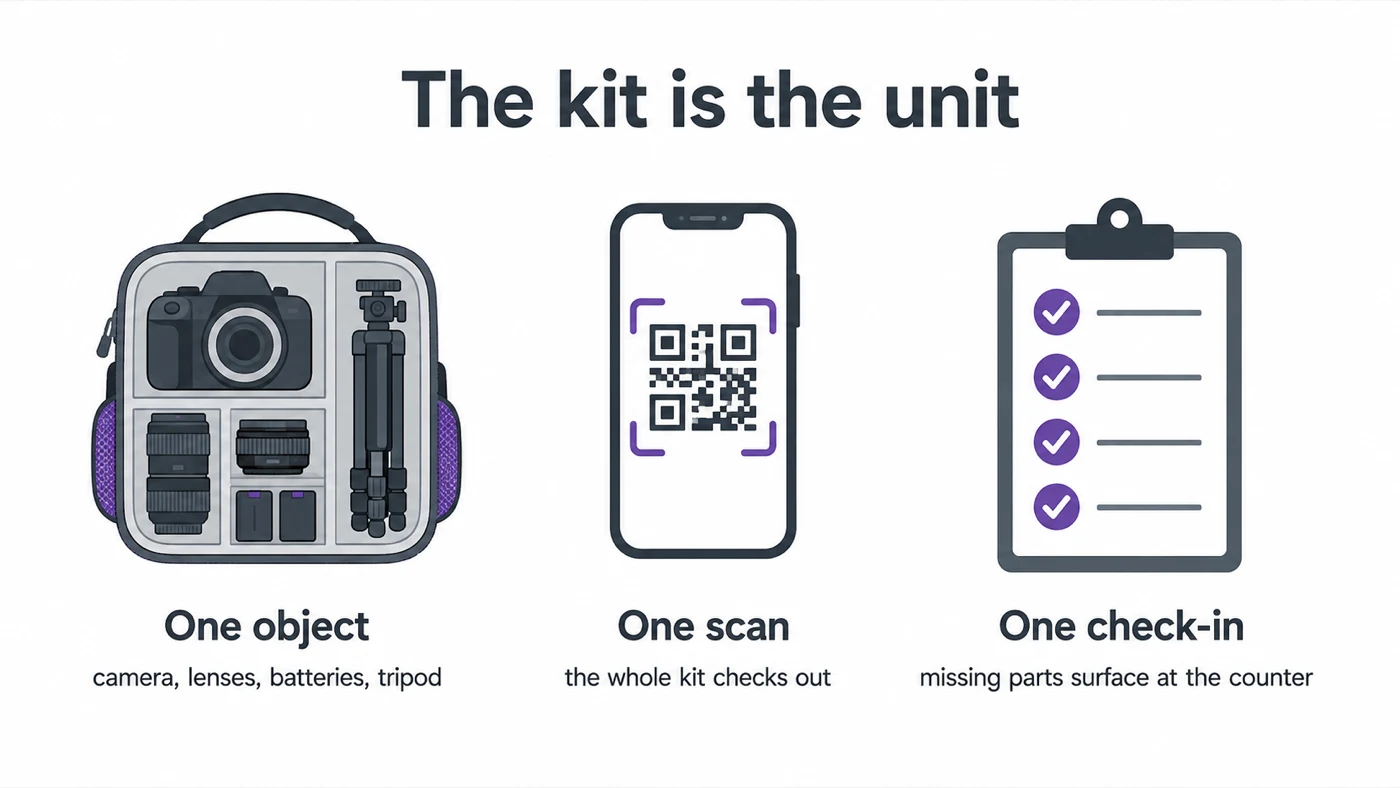
Nobody borrows "a camera". They borrow a camera, two lenses, four batteries, a charger, a tripod plate and the bag — and the return is where sets quietly dissolve. Build the kits as first-class objects: the "Doc Kit A" checks out as one scan and checks in with a completeness look-over against its parts list. Two effects: pickup gets faster, and incomplete returns become visible at the counter — while the borrower is standing there and the missing battery is findable — instead of surfacing mid-shoot for the next crew.
Rules that survive a student population
Gear-room policy has to run impersonally, because the staff rotates and the borrowers are peers:
- Rights follow the course, not the person. Intro students get the B-kits; the advanced production course unlocks the cinema camera. Encoding this as permissions removes the counter argument — "the system won't let me" is a kinder no than a sophomore's judgement call.
- Blocks are automatic and forgivable. Overdue gear blocks new bookings until it's back. The rule enforces itself, applies to everyone, and ends the moment the item lands on the counter.
- Condition is recorded in the open. Checkout and return condition noted with the borrower present. Most damage disputes aren't dishonesty — they're genuine uncertainty that a photo settles.
- Semester end works like year-end at a school: the outstanding list is the process. Reminders escalate through the term's final weeks; the last few days handle exceptions, with registrar holds as the endgame only for the genuinely unresponsive.
Surviving turnover — the quiet killer
The gear room's real enemy isn't theft; it's discontinuity. The technician who "knew the systems" retires; the spreadsheet's logic leaves with them; the new person starts from zero and the first semester leaks. The fix is dull and decisive: the register, the bookings, the histories and the rules live in the system, not in anyone's head. A new student assistant should be productive at the counter in fifteen minutes — scan, confirm, next — and a new manager should inherit dashboards, not folklore.
That's also the honest budget argument. A department doesn't buy software to have software; it buys the version of this room where the £40k of kit is where the system says it is, semester end takes days instead of weeks, and nobody's continuity depends on a hero. The core loop — booking, scan checkout, reminders, history — is what delivers that, and it doesn't require an institution-wide platform or an institution-sized invoice. Start with the contested kits, label as you go, and let the rest of the shelf join over a term.
The gear will still come back sandy. But it'll come back — on a date the system knew about, to a record that noticed.
Frequently Asked Questions
-
The core loop is booking ahead for contested gear, scan-based checkout against the student's record at pickup, due dates measured in days, and automatic reminders. The room's history per item and per student is what keeps damage and loss conversations factual.
-
Volume and turnover. A gear room makes thousands of short loans a year to borrowers who graduate every few years, so the system has to onboard borrowers cheaply, enforce rules impersonally, and keep working when the student assistant behind the desk changes every semester.
-
No. The enterprise platforms in this space are priced for institution-wide deployments. A department needs the core loop — booking, scan checkout, reminders, history — which lighter tools deliver at a price a course budget can absorb.