
How to stop double-booking shared equipment
Two crews, one generator, same Monday. Double bookings aren't a discipline problem — they're what happens when promises about the future are stored in places that can't see each other. Here's how to fix the system instead of the people.
In this article
- Why every informal channel fails the same way
- Why "just communicate better" never fixes it
- The three-part fix
- Rules that keep the calendar honest
- The payoff is bigger than avoided collisions
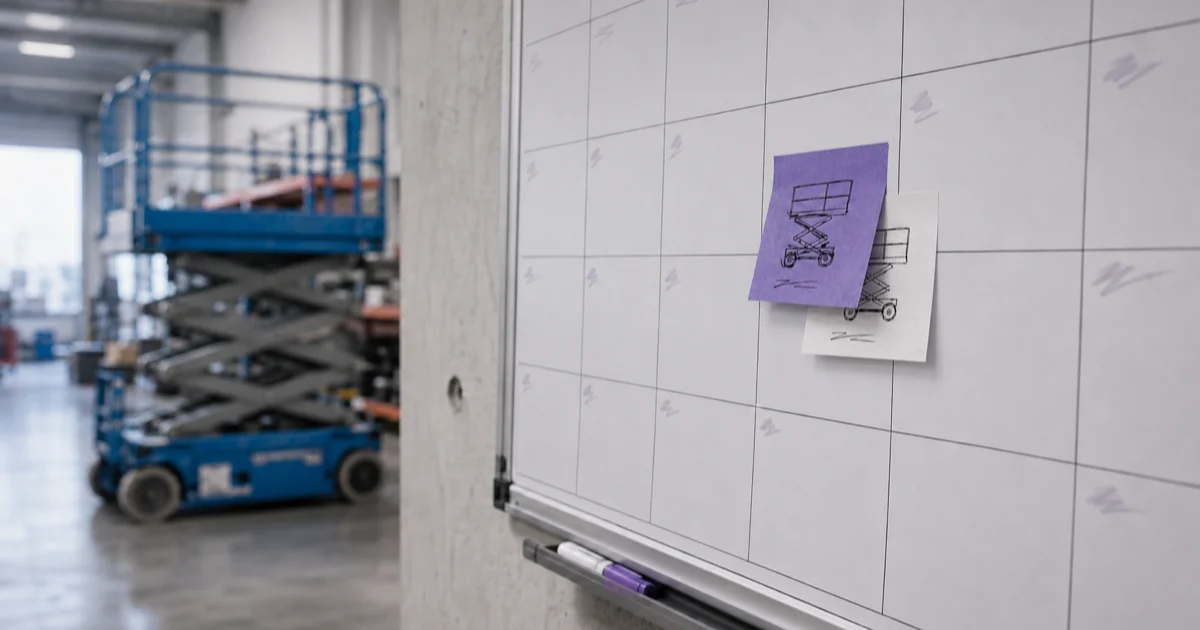
The site crew booked the lift weeks ago — by telling Espen, who wrote it on a Post-it. The service team booked the same lift last Tuesday — in an email nobody else was on. Both show up Monday at 07:00. One of them is now renting a lift at short-notice prices, and both of them think the other one is the problem.
Neither is. Double bookings are a storage problem: promises about future equipment use, stored in places that can't see each other. You don't fix that with a sterner memo. You fix it by giving the promises one home.
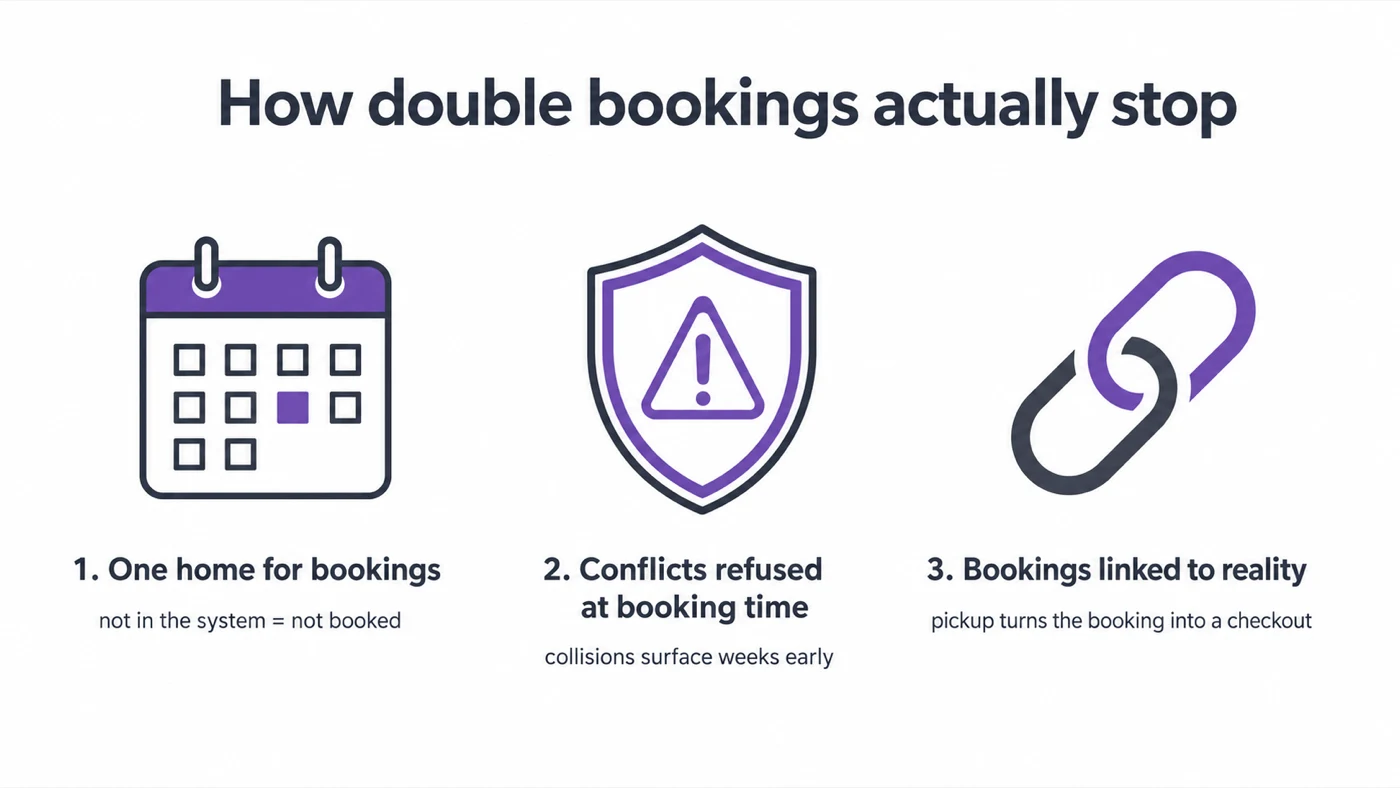
The short answer: put every booking in one system, have that system refuse (or flag) conflicting bookings at the moment they're made, and link each reservation to the actual pickup and return. Do those three things and double bookings stop being a discipline issue, because the second promise physically can't be stored. The rest of this article is how to get there — and how to keep the calendar honest once you have.
Why every informal channel fails the same way
Compare the places bookings usually live against the four things a booking channel actually has to do:
| Where bookings live | Sees the future | Refuses conflicts | Understands kits | Knows what's really out |
|---|---|---|---|---|
| Email / chat threads | ✗ scattered | ✗ | ✗ | ✗ |
| Whiteboard / Post-its | ✗ shows today | ✗ | ✗ | Partly |
| Shared calendar (Outlook/Google) | ✓ | ✗ accepts overlaps | ✗ | ✗ |
| Spreadsheet | ✓ if maintained | ✗ | ✗ | ✗ trusts humans |
| Equipment reservation system | ✓ | ✓ at booking time | ✓ incl. accessories | ✓ linked to checkouts |
A generic shared calendar is the most common half-fix — it makes bookings visible, which feels like progress, but it happily accepts two overlapping events and has no idea the camera kit contains a tripod that's also booked. Visibility without refusal just means you get to watch the collision coming.
Why "just communicate better" never fixes it
A booking is a claim on a specific item for a specific window of time. For claims not to collide, every claim has to be checked against every other claim — and humans are terrible at this precisely when it matters: at the end of a busy day, for a booking three weeks out, for the second generator that looks identical to the first.
The email thread can't refuse a conflicting reply. The Post-it can't warn about next Thursday. The whiteboard shows today, not the future. Every informal channel shares the same flaw: nothing checks the new promise against the old ones.
The three-part fix
1. One place where all bookings live
Not one person — one system. The rule that changes everything is brutally simple: if the booking isn't in the system, the equipment isn't booked. No side agreements, no verbal holds, no seniority exceptions. The moment two channels exist, you're back to colliding promises.
A shared calendar per item is the minimum viable version of this. A proper equipment reservation system is the grown-up version — the difference is what happens next.
2. Conflict checks at booking time, not pickup time
The whole value of centralising bookings is that the system can now refuse the second claim — or at least flag it — the moment it's made, while there's still time to plan around it. That Thursday-morning collision should have been discovered as a red warning three weeks earlier, when the second booking was being typed and every alternative was still available.
This is also where generic calendars quietly fail: they accept overlapping events without complaint, and they don't understand that booking the camera kit also books the tripod, the lenses and the batteries inside it. Equipment-aware booking checks the whole set.
3. Bookings connected to reality
A reservation is a plan; the equipment leaving the shelf is a fact. If the two aren't linked, plans drift: gear comes back early and sits "booked" while nobody dares touch it, or goes out late and the next reservation starts against equipment that isn't there.
Link them: picking up a reservation converts it into a checkout, returning ends it, and the calendar reflects what's actually available — not what was planned two weeks ago. This link is also what makes the history useful later: you can see not just what was booked, but whether it was really used, which is the question that decides whether you own too much or too little of something.
Rules that keep the calendar honest
- Book the window you need, not the window you fear. Padding every booking "to be safe" recreates scarcity. Overdue reminders — automated, not personal — are the mechanism that makes short bookings safe to make.
- Recurring needs get recurring bookings. The Tuesday inspection kit shouldn't be re-booked 52 times by hand — that's how one Tuesday gets missed and collided with.
- Name a tiebreaker. Conflicts will still occasionally need a human call. One named person decides; the system's job is making sure the conflict surfaces early enough for the call to be cheap.
- Cancel what you won't use. A no-show booking blocks a colleague as effectively as a real one. Cancelling in ten seconds from a phone is what makes this rule realistic.
The payoff is bigger than avoided collisions
Teams fix double bookings and then notice the side effects: utilisation becomes visible (that lift is booked 9% of the time — why do we own two?), planning conversations shorten (the calendar answers instead of a meeting), and the standing low-grade friction between crews who kept "stealing" each other's gear simply evaporates. It was never a people problem.
One home for bookings, conflicts caught at booking time, and reservations tied to actual pickups. Everything else is enforcement detail.
Frequently Asked Questions
-
Because bookings live in different places — one crew's plan is in an email, another's in someone's head, a third in a spreadsheet. No single record can refuse the second booking, so the conflict is only discovered at the shelf.
-
Partly. Creating one calendar per item makes availability visible, but generic calendars happily accept overlapping events, don't understand kits or accessories, and know nothing about whether the item actually came back. It's better than email, and it still leaks.
-
A reservation is a promise about the future — this projector is yours next Thursday. A checkout is the record that it physically left the shelf. A working system links the two, so a reservation converts into a checkout when the equipment is picked up.